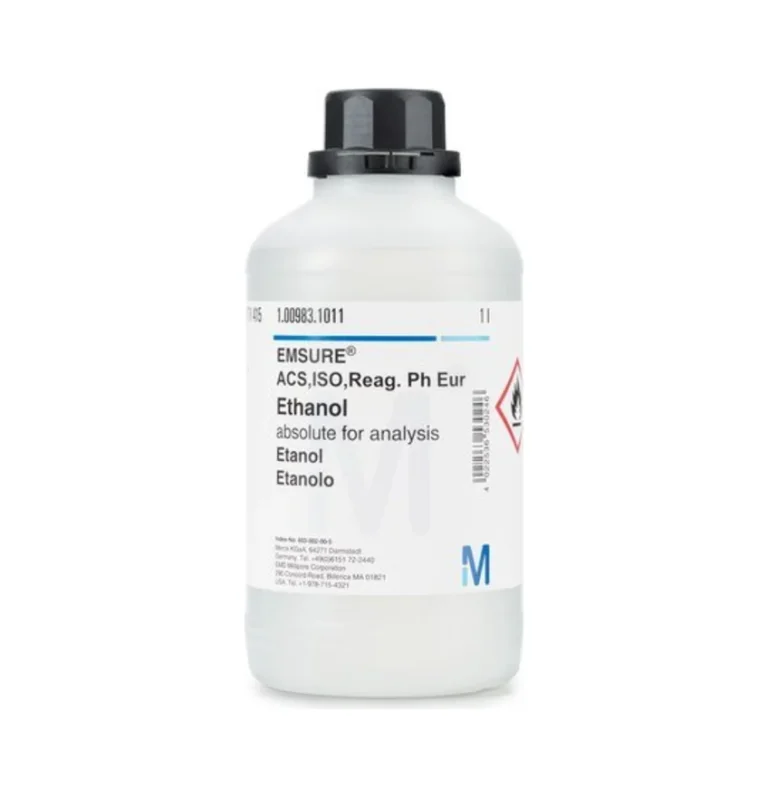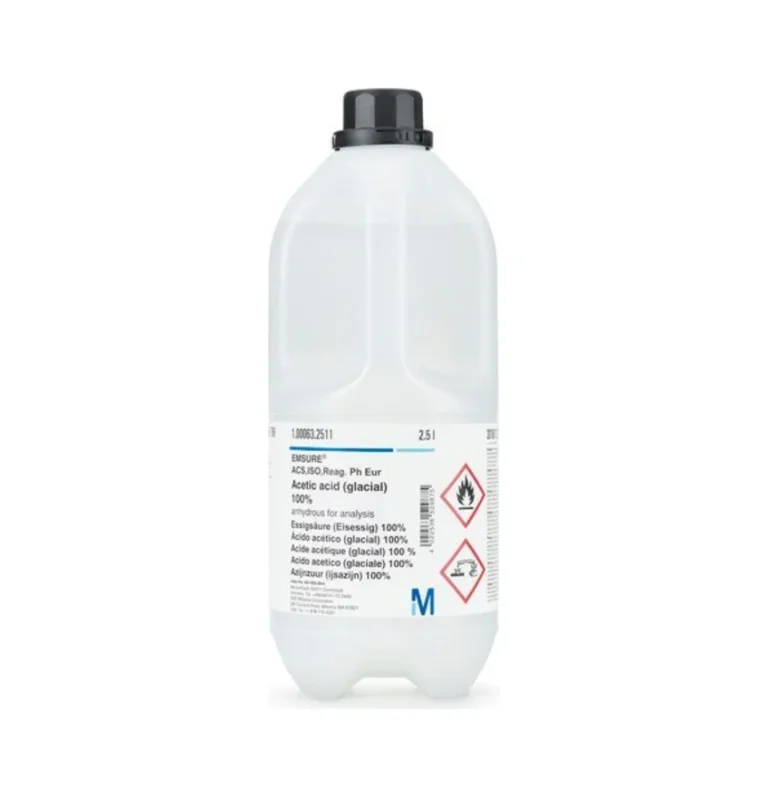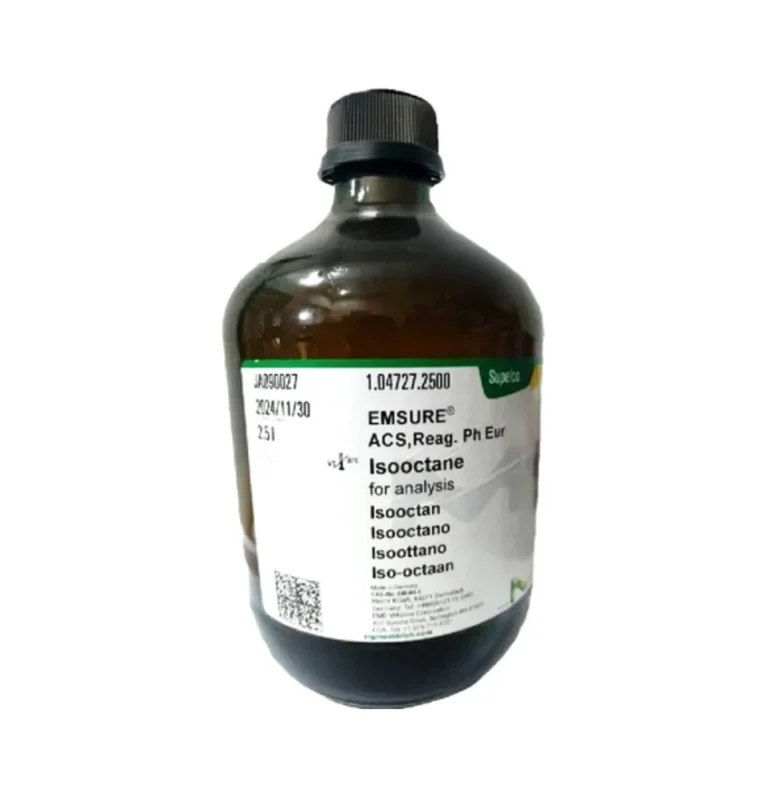

Short answer: the letters after a reagent’s grade name say which outside body’s published specification the batch also meets. ACS is the American Chemical Society specification, ISO is ISO 6353, Reag. Ph Eur is the European Pharmacopoeia reagent monograph and USP is the United States Pharmacopeia.
They are not ranks. A reagent can carry all four, and many do — of the reagent lines in this catalogue, 29 cite ISO, 20 cite Ph. Eur., 19 cite ACS and 4 cite USP.
This guide sits under the analytical reagent grades guide, which covers what the grades themselves — EMSURE, LiChrosolv, Suprapur and the rest — actually control.
Who specifies what
| Mark | Published by | What it fixes | Reached for when |
|---|---|---|---|
| ACS | American Chemical Society, in Reagent Chemicals | Assay plus a list of maximum impurity limits and the test methods for them | A method or an SOP was written against ACS specifications |
| ISO | ISO, in the ISO 6353 series | General test methods and per-substance specifications | An internationally harmonised specification is wanted |
| Reag. Ph Eur | European Pharmacopoeia | The reagent monograph used in Ph. Eur. test methods | The analysis follows a Ph. Eur. monograph |
| USP | United States Pharmacopeia | The reagent requirements behind USP–NF methods | The analysis follows a USP–NF monograph |
The two pharmacopoeial marks are different in kind from the other two. ACS and ISO describe a good analytical reagent in general. Ph. Eur. and USP exist so that a specific published test method produces the same answer in every laboratory that runs it — which is why, in pharmaceutical QC, the mark is often not a preference but a requirement written into the method.
Reading a real label
Take a line from this catalogue:
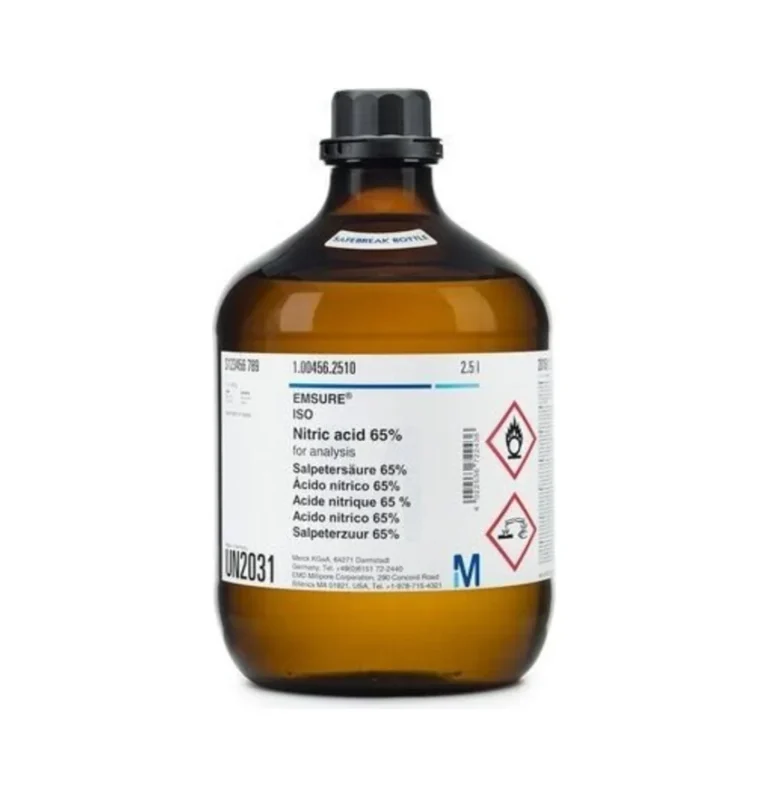
Nitric acid 65%, for analysis EMSURE® Reag. Ph Eur, ISO. CAS Number: 7697-37-2
Four separate claims are stacked there:
- Nitric acid 65% — the substance and its concentration.
- for analysis EMSURE — the manufacturer’s analytical grade and its internal specification.
- Reag. Ph Eur, ISO — the batch also meets the European Pharmacopoeia reagent monograph and the ISO specification.
- CAS 7697-37-2 — the unambiguous identity of the substance, independent of any name or translation. The CAS number guide covers why the name alone is not enough.
A purchase specification that quotes all four leaves the supplier no room to substitute. One that says “nitric acid, analytical” leaves a great deal.
The certificate of analysis is where the claim is proved
A grade and a certification are claims about a specification. The certificate of analysis is the evidence that this batch met it.
Four things to check when one arrives:
- Is it lot-specific? A lot-specific CoA carries results measured on the batch you received. A “typical values” sheet carries figures representative of the product line. Only the first is evidence about your bottle.
- Does the lot number match the bottle in your hand? This is the single most common gap found in an audit — a filed CoA for a lot that was used up two deliveries ago.
- Are results reported, or only limits? “Heavy metals: ≤ 0.5 ppm” is a limit. “Heavy metals: 0.1 ppm” is a result. Methods that require a measured value need the second.
- What is the retest or expiry date? Reagents rarely “expire” in the food sense; they carry a date after which the manufacturer no longer warrants the specification without retesting.
File the CoA against the lot number, not the product name, and keep it for as long as the results it supported are retained.
When a certification is not optional
Three situations turn a preference into a requirement:
- The method names it. A Ph. Eur. or USP monograph that specifies a reagent of that pharmacopoeial quality has made the choice for you.
- Your accreditation scope names it. If the SOP registered under your scope says ACS grade, using something else is a deviation, however good the substitute.
- A customer specification names it. Contract laboratories inherit their clients’ requirements, and those are usually written by reference rather than by property.
Outside those three, the certification is a quality signal to be weighed against price and availability like any other.
The question an assessor asks is never “is this a good reagent”. It is “show me why this reagent was the right one for this method, and show me the paper that proves the batch met it”.
PT Praglas Raya technical team
What none of these marks tell you
A certification says the batch met a specification when it was tested and released. It says nothing about what happened afterwards.
This matters most for certified reference materials, where the number on the certificate is the product — see the calibration standards guide. An opened bottle of a hygroscopic solvent, a light-sensitive reagent left on a sunny shelf, or a titrant that has been absorbing carbon dioxide for six months no longer matches its certificate — and no mark on the label prevents that. Storage is the other half of the problem, and it is covered in the reagent storage and shelf life guide.
Frequently asked questions
What does Reag. Ph Eur mean on a reagent bottle?
That the batch meets the reagent monograph of the European Pharmacopoeia. It is required when the analytical method being run is itself a Ph. Eur. method, and it is a strong quality signal otherwise.
Is ACS grade better than ISO grade?
Neither is above the other. They are specifications published by different bodies, and the limits they set for a given impurity may differ slightly. Many reagents carry both marks because the batch satisfies both. Choose by what your method or SOP references.
What is the difference between a lot-specific CoA and typical values?
A lot-specific certificate reports measurements made on your batch. A typical-values sheet reports figures representative of the product. For traceability, only the lot-specific document counts as evidence.
Does a reagent certification cover the container it comes in?
Not directly, but the packaging is part of how the specification is maintained — amber glass for light-sensitive material, particular closures for solvents that attack liners. Decanting a certified reagent into an unsuitable bottle voids the practical value of the certificate.
Do I need a certification for reagents used in cleaning or rinsing?
No. Non-analytical use is where a technical grade belongs, and buying certified material for it is money spent on paperwork nobody will read.
Sources and further reading
- ISO 6353-1:1982 — Reagents for chemical analysis: General test methods
- ISO 6353-2:1983 — Reagents for chemical analysis: Specifications, first series
- ISO 6353-3:1987 — Reagents for chemical analysis: Specifications, second series
- USP–NF General Chapter <31> — Volumetric Apparatus
- European Pharmacopoeia reagent monographs; American Chemical Society, Reagent Chemicals
Certification counts are taken from the Merck reagent lines listed on this site. Browse analytical reagents, read the reagent grades guide, or talk to our technical team with the monograph your method references.