Short answer: a reagent grade is a specification, not a purity figure. Two bottles both marked ≥99.9% can be built to entirely different specifications — one controlling water and heavy metals for wet chemistry, the other controlling UV absorbance and gradient baseline for HPLC.
Buy the grade that matches the measurement, not the highest number on the label. Of the 100 Merck reagents in this catalogue, 56 are EMSURE analytical grade, 6 are LiChrosolv chromatography solvents, 6 are Certipur certified standards, 4 are Suprapur for trace metals and 2 are Titripur volumetric solutions.
This is the hub for the reagent side of the catalogue. It covers what each grade controls, how the certifications on the label differ from the grade itself, and how to choose. The equivalent guide for glassware is the accuracy class guide.
Purity is the wrong question
Assay is one line on a specification. What separates grades is everything underneath it — which impurities are controlled, at what level, and by what test.
Take the two solvents in this catalogue that are both stated as ≥99.9% by GC:
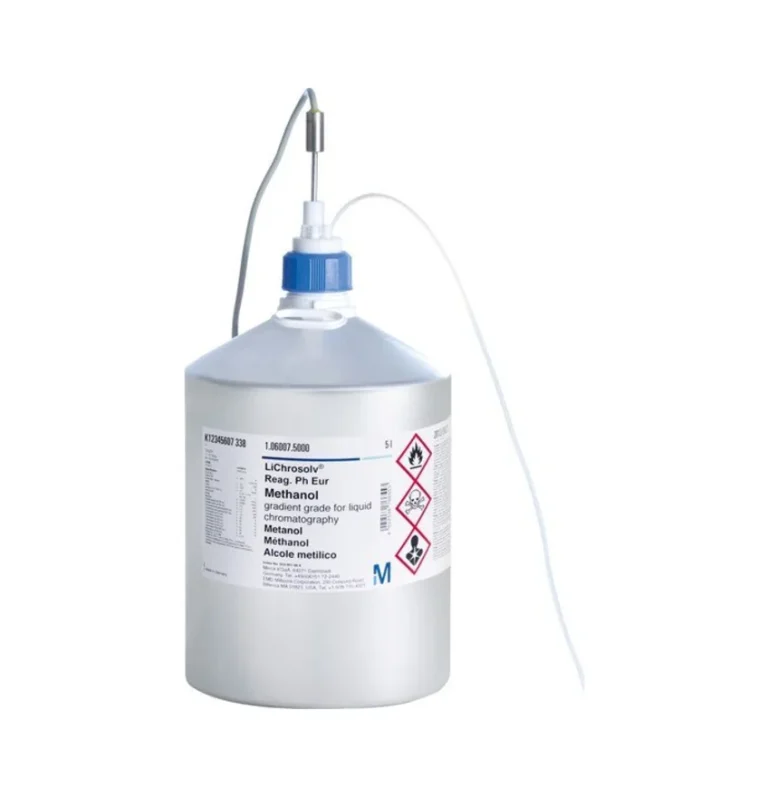
- Methanol, gradient grade for liquid chromatography — the specification that matters is UV transmission across the working wavelengths and a flat gradient baseline. Trace non-volatile residue and UV-absorbing impurities are the enemy, because they appear as ghost peaks in a chromatogram.
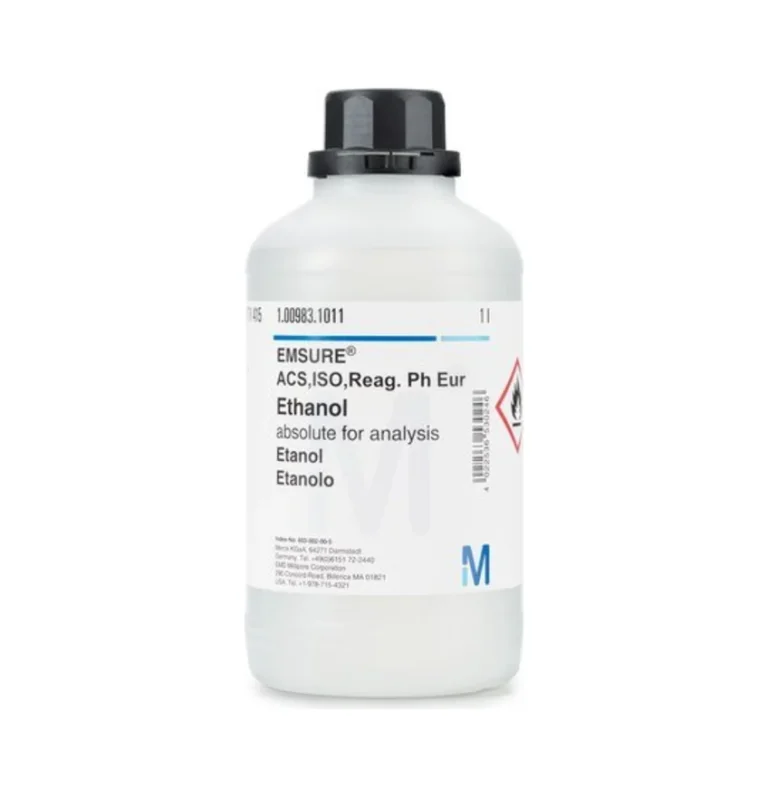
- Ethanol absolute for analysis — the specification that matters is water content, residue on evaporation, acidity and heavy metals. UV behaviour is not the point.
Both are 99.9% pure. Run the second one on a gradient HPLC method and the baseline will tell you why the distinction exists.
The grades in this catalogue
| Grade | Controls | Use it for | Lines stocked |
|---|---|---|---|
| EMSURE | Assay, water, residue, heavy metals, and the impurities named by ACS, ISO or Ph. Eur. | General analytical chemistry, sample preparation, wet methods | 56 |
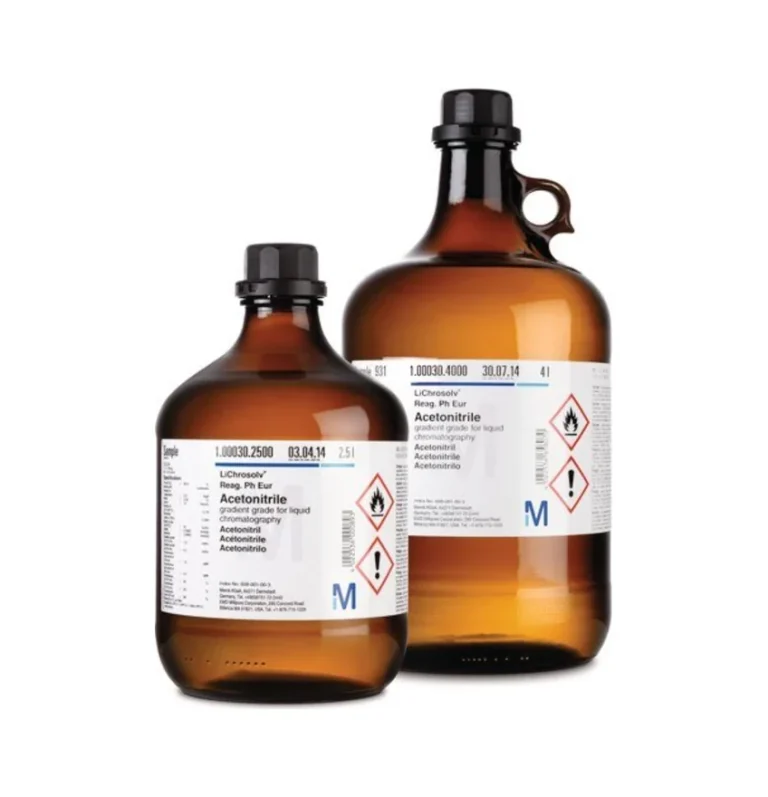
| LiChrosolv | UV transmission, gradient baseline, non-volatile residue, filtration | HPLC and UHPLC, particularly gradient methods | 6 |
| Certipur | A certified value with a stated uncertainty, traceable to a national standard | Calibrating instruments — pH, conductivity, AAS and ICP standards | 6 |
| Suprapur | Metal impurities at trace and ultratrace level | AAS, ICP-OES and ICP-MS, where the blank decides the detection limit | 4 |
| Titripur | Concentration of a volumetric solution, with a stated factor | Titration against a known concentration | 2 |
The distribution is what you would expect of a general laboratory supplier: most demand is ordinary analytical work, with specialist grades stocked in depth only where a cheaper substitute would ruin the measurement.
Grade and certification are two different claims
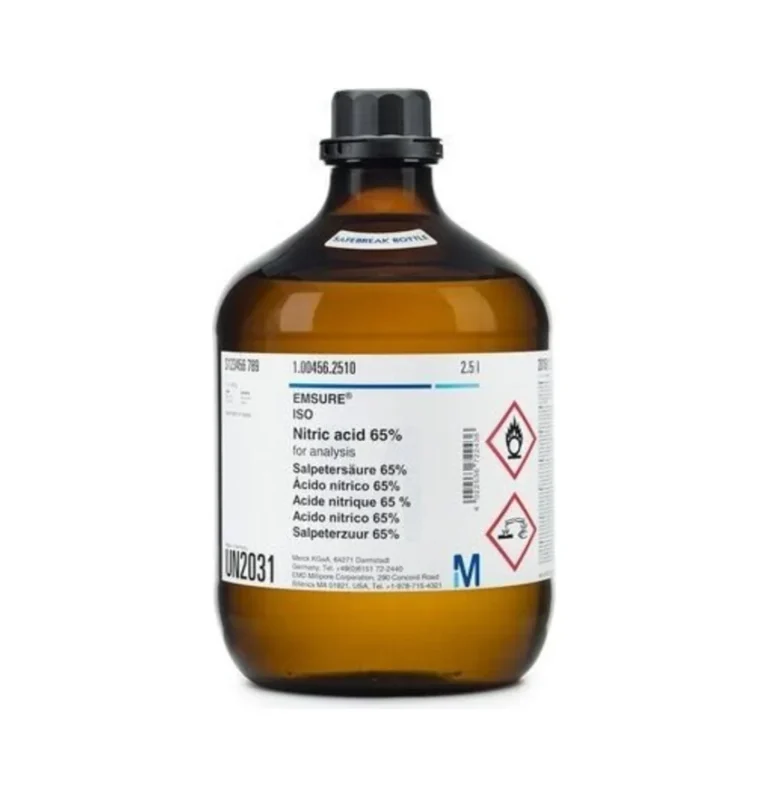
A label like for analysis EMSURE® ACS, ISO, Reag. Ph Eur is making two separate statements.
The grade — EMSURE — is the manufacturer’s product line and its internal specification. The certifications — ACS, ISO, Reag. Ph. Eur., USP — say that the batch also meets the published requirements of an outside body. Across this catalogue, 29 lines cite ISO, 20 cite Ph. Eur., 19 cite ACS and 4 cite USP.
That distinction matters when an auditor asks why a particular reagent was chosen. “It is our usual grade” is a weaker answer than “it is certified to the pharmacopoeial monograph the method references”. What each of those marks actually guarantees is covered in the guide to reagent certifications.
Choosing by method
| What you are doing | Grade | Why |
|---|---|---|
| HPLC, gradient elution | LiChrosolv | Baseline and UV cut-off are specified; analytical grade is not |
| Trace metals by ICP or AAS | Suprapur | The reagent blank sets your detection limit |
| Titration against a known concentration | Titripur | Supplied with a certified factor, no standardisation needed |
| Calibrating a pH meter or conductivity cell | Certipur | Certified value with a traceable uncertainty |
| Digestion, extraction, general wet chemistry | EMSURE | Controls the impurities that interfere with classical methods |
| Cleaning, rinsing, non-analytical use | Technical grade | Analytical grade here is money burned |
Two failure modes, and both cost the same money. Buying a grade below the method throws away the result. Buying a grade above it throws away the budget — and analytical-grade solvent used for rinsing is the most common way we see that happen.
PT Praglas Raya technical team
The CAS number is the identity, the grade is the quality
A chemical name can be ambiguous; a CAS Registry Number cannot. Ethanol is 64-17-5, glacial acetic acid is 64-19-7, nitric acid is 7697-37-2. Ordering by name alone invites substitution between hydrates, isomers and salts that share a common name.
Of the 100 reagent lines in this catalogue, 32 carry the CAS number in their product description. When placing an order for anything where identity could be ambiguous, quote the CAS number and the pack code together — the pack code fixes the grade and the size, the CAS number fixes the substance.
Guides in this series
- ACS, ISO and Ph. Eur.: what a reagent certification guarantees — which body specifies what, how to read the certificate of analysis, and when a pharmacopoeial grade is mandatory rather than preferable.
- Reagent storage, shelf life and handling — light, temperature, incompatible neighbours, and why an opened bottle has a different life to a sealed one.
Browse the reagent catalogue directly: analytical reagents (88 lines) and pro analysis (100 lines).
Frequently asked questions
What is the difference between EMSURE and LiChrosolv?
EMSURE is an analytical grade specified for classical wet chemistry — assay, water, residue, heavy metals. LiChrosolv is specified for chromatography, where UV transmission, gradient baseline and non-volatile residue decide whether a chromatogram is usable. A solvent can meet one specification and fail the other at the same nominal purity.
Can I use analytical grade solvent for HPLC?
For an isocratic method with detection well above the solvent cut-off, sometimes. For gradient work, no — analytical grade is not specified for gradient baseline behaviour, and the ghost peaks that result are indistinguishable from sample peaks until you run a blank gradient.
What does Suprapur mean and when do I need it?
It is a grade specified for very low metal impurities, intended for trace and ultratrace elemental analysis. You need it when the reagent blank, rather than the instrument, sets your detection limit — typically in ICP-MS, ICP-OES and graphite furnace AAS.
Do I still have to standardise a Titripur volumetric solution?
It is supplied with a certified concentration and factor, so it can be used directly on receipt. Whether you re-standardise afterwards depends on your quality system, how long the bottle has been open, and whether the titrant is one that changes on storage — sodium hydroxide absorbs carbon dioxide from the air regardless of how it arrived.
Is a higher grade always safer?
Safer for the result, wasteful for the budget, and occasionally wrong: a certified reference material used as a bulk reagent consumes a standard you will need for calibration. Match the grade to the measurement.
Sources and further reading
- ISO 6353-1:1982 — Reagents for chemical analysis: General test methods
- ISO 6353-2:1983 — Reagents for chemical analysis: Specifications, first series
- ISO 6353-3:1987 — Reagents for chemical analysis: Specifications, second series
- USP–NF General Chapter <31> — Volumetric Apparatus
- European Pharmacopoeia (Ph. Eur.) reagent monographs, and the American Chemical Society specifications for reagent chemicals
For the fields a reagent purchase request needs, see the purchasing guide.
Grade counts are taken from the 100 Merck reagent lines listed on this site. Browse the full catalogue of 143 laboratory products or talk to our technical team about a grade for a particular method.