Short answer: a Class AS burette holds twice the accuracy of a Class B burette of the same capacity — ±0.05 ml against ±0.10 ml at 25 ml and 50 ml. Specify Class AS for any titration whose result is reported, and Class B for teaching, screening and titrations where the acceptance limit is 1% or wider.
The number that matters is not the tolerance but the tolerance as a share of your titre. A 10 ml titre delivered from a Class B 25 ml burette carries ±1.0% before the chemistry is considered.
Burette classes are set by ISO 385, with the general design rules in ISO 384. This guide sits under the site’s broader guide to laboratory glassware accuracy classes, which compares the same class markings across flasks, pipettes and cylinders.
What the AS in Class AS actually means
Class AS is not a grade between A and B. It carries the same volumetric tolerance as Class A. What it adds is a specified delivery time and a 30-second waiting time — after the tap is closed, thirty seconds elapse before the meniscus is read, allowing the film of liquid on the burette wall to drain down and join the bulk.
Class A specifies no waiting time. That sounds like a small distinction until two analysts read the same burette at different moments and produce results that differ by more than the tolerance. AS removes the judgement call by writing the pause into the standard.
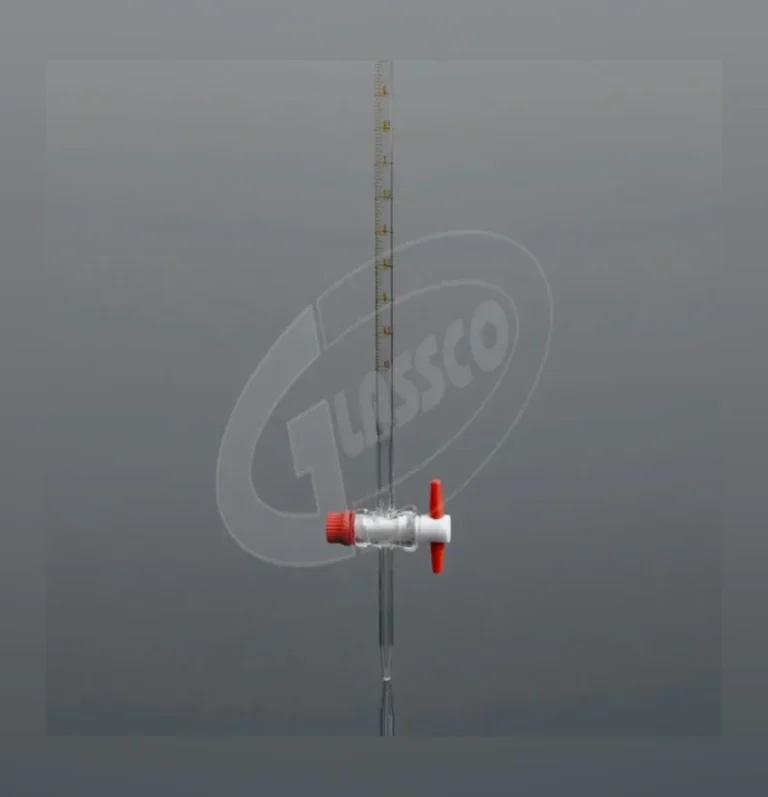
For titration work, AS is the grade to buy. Every GLASSCO burette in the Praglas range above Class B is supplied as Class AS. The designation appears on pipettes too, for the same reason — both are draining instruments.
Tolerance by capacity: the GLASSCO burette range
The figures below are the published specifications for the burettes PT Praglas Raya stocks. The relative column is the tolerance as a percentage of the burette’s full capacity.
| Capacity | Division | Class AS tolerance | Relative | Class B tolerance | Relative |
|---|---|---|---|---|---|
| 10 ml | 0.05 ml | ±0.03 ml | 0.30% | ±0.05 ml | 0.50% |
| 25 ml | 0.1 ml | ±0.05 ml | 0.20% | ±0.10 ml | 0.40% |
| 50 ml | 0.1 ml | ±0.05 ml | 0.10% | ±0.10 ml | 0.20% |
| 100 ml | 0.2 ml | ±0.10 ml | 0.10% | — | — |
Two things fall out of that table. The Class B limit is exactly twice the Class AS limit at every capacity where both are offered, which is the ISO relationship holding as it does across all volumetric glassware. And the small burettes are the inaccurate ones in relative terms: a 10 ml Class AS burette is three times looser, as a share of its capacity, than a 50 ml one.
What the class costs you in a titration
Full-capacity tolerance is the specification, but nobody titrates the whole burette. What matters is the tolerance against the volume actually delivered.
| Burette | Titre | Class AS error | Class B error |
|---|---|---|---|
| 50 ml | 40 ml | 0.13% | 0.25% |
| 50 ml | 20 ml | 0.25% | 0.50% |
| 25 ml | 20 ml | 0.25% | 0.50% |
| 25 ml | 10 ml | 0.50% | 1.00% |
| 10 ml | 5 ml | 0.60% | 1.00% |
This is the practical rule that comes out of it: size the burette so the titre lands in the upper half of its capacity. A 20 ml titre run from a 50 ml burette and the same titre run from a 25 ml burette carry the same absolute tolerance, but the analyst who dilutes their sample to use more of the burette halves the relative error at no cost.
Division is not tolerance
The division is what is printed on the glass. The tolerance is what the manufacturer guarantees about where those printed marks sit.
A 50 ml burette is divided in 0.1 ml steps, and a trained analyst estimates the meniscus to roughly a fifth of a division — about 0.02 ml. That reading resolution is finer than the ±0.05 ml Class AS tolerance and much finer than the ±0.10 ml Class B tolerance.
The consequence is worth stating plainly: on a Class B burette, the glassware is the dominant error, not the analyst. Reading more carefully cannot recover it. Buying the higher class can.
Schellbach stripe, and when it earns its price
A Schellbach burette carries a blue line on a white stripe running the length of the barrel behind the graduations. Seen through the liquid, the stripe pinches into two opposed arrowheads that meet exactly at the bottom of the meniscus.
It does not change the tolerance — the Schellbach model and the clear glass model hold the same ±0.05 ml at 25 and 50 ml. What it changes is repeatability between operators, and it earns its price in three situations: coloured or turbid titrants where the meniscus is hard to see, laboratories where several analysts share one burette, and teaching, where consistent reading technique is the thing being taught.
For a single experienced analyst titrating clear solutions, clear glass is the cheaper and equally accurate choice.
PTFE key or glass stopcock
Both are offered at Class AS, and the choice is chemical rather than volumetric.
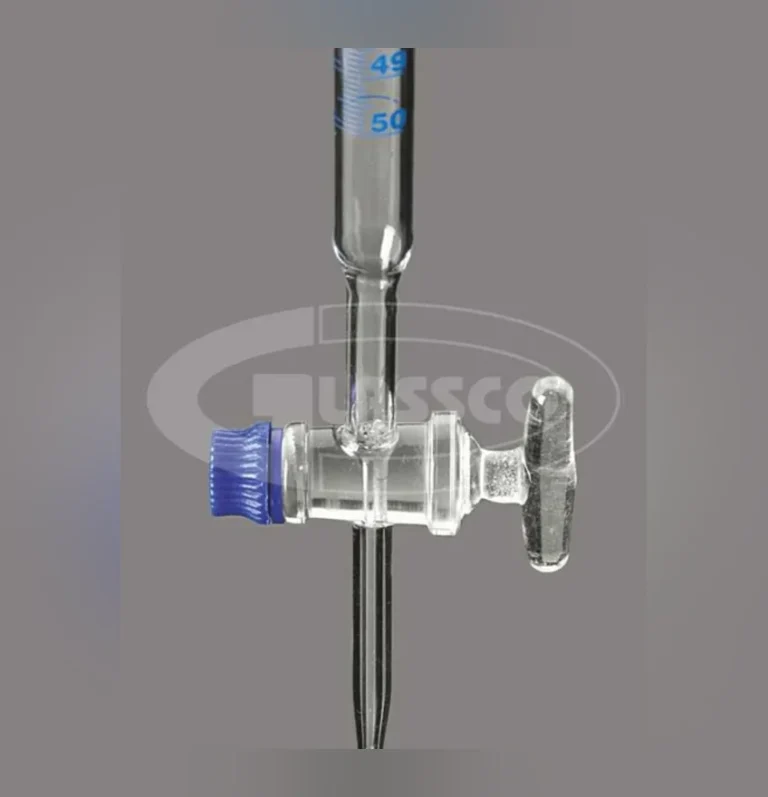
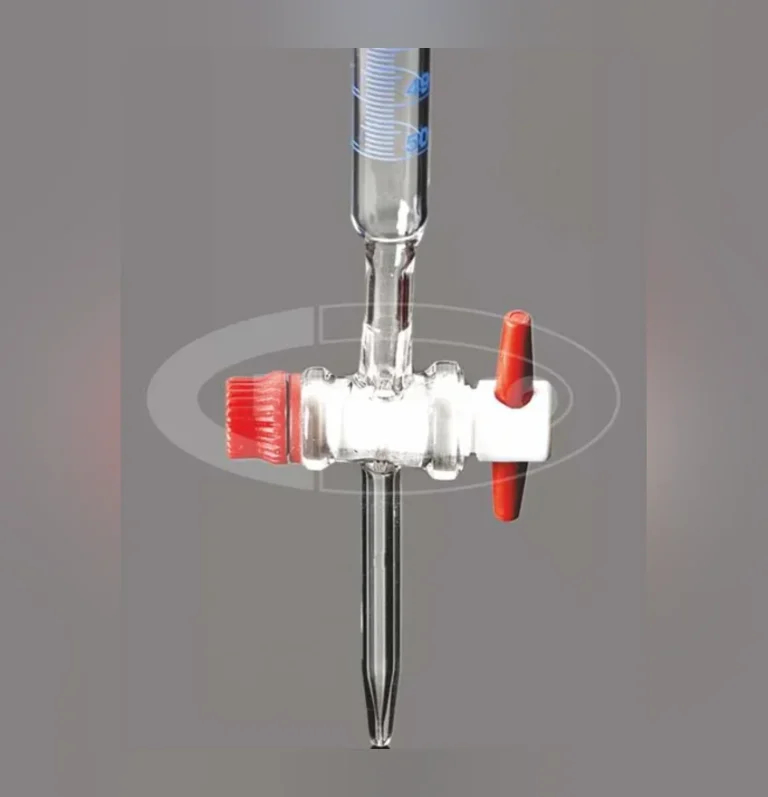
- PTFE key — needs no grease, will not seize, and is unaffected by alkali. The default for hydroxide titrations and for any laboratory that wants one fewer consumable. Clear glass and Schellbach versions are both stocked.
- Glass stopcock — requires grease, gives a very fine flow control that some analysts prefer for approaching an endpoint drop by drop, and is vulnerable to seizing if alkali is left standing in the barrel. Stocked as the Class AS glass stopcock burette.
Nearly every seized burette we are asked to replace held sodium hydroxide overnight in a greased glass stopcock. The glass is not at fault and neither is the analyst — the wrong stopcock was specified for the chemistry.
PT Praglas Raya technical team
A decision table for procurement
| Application | Class | Capacity | Stopcock |
|---|---|---|---|
| Reported analytical results, accredited methods | AS | 50 ml, or 25 ml for small titres | PTFE |
| Hydroxide and alkaline titrants | AS | 50 ml | PTFE, no exceptions |
| Shared bench, several analysts | AS Schellbach | 50 ml | PTFE |
| Coloured or turbid titrant | AS Schellbach | 50 ml | PTFE |
| Teaching laboratory | B, or AS Schellbach where budget allows | 25 or 50 ml | PTFE |
| Screening, method development, wide limits | B | 25 or 50 ml | PTFE |
Verifying a burette you already own
ISO 4787 gives the gravimetric method, and for a burette it is run on the delivered volume rather than the contained volume — a burette is calibrated to deliver, marked Ex, unlike a volumetric flask, which is calibrated to contain.
- Fill above the zero mark, then set the meniscus to zero and touch off the drop at the jet.
- Deliver a nominal volume into a weighed, stoppered flask at the standard rate, with the jet not touching the wall.
- Wait the specified 30 seconds, then read.
- Weigh the receiver again and convert the mass difference to volume at the measured water temperature, applying the buoyancy correction.
- Repeat at several points on the scale — a burette can be within tolerance at 50 ml and outside it at 10 ml.
That last point catches people out. Flask verification is one measurement; burette verification is a curve.
Frequently asked questions
Is a Class AS burette the same as Class A?
The tolerance is identical. Class AS additionally specifies a delivery time and a 30-second waiting time before the final reading. For titration, Class AS is the practical choice because the waiting time is defined by the standard rather than left to the analyst.
How much less accurate is a Class B burette?
Exactly half as accurate: the Class B tolerance is twice the Class A or AS limit at every capacity. At 25 ml that is ±0.10 ml against ±0.05 ml, and at 50 ml the same pair of figures. Whether that matters depends entirely on the size of your titre.
Which burette capacity should I buy?
The one that puts your usual titre in its upper half. A titre that consumes 20 to 40 ml of a 50 ml burette gives a relative error of 0.13 to 0.25% at Class AS. The same titre run from an oversized burette wastes accuracy you have already paid for.
Does a Schellbach stripe make a burette more accurate?
Not in the specification — the tolerance is unchanged. It improves reading repeatability, particularly between different operators and with coloured or turbid solutions. It buys precision in use, not accuracy in manufacture.
Should I use a PTFE or glass stopcock for NaOH titrations?
PTFE. Alkali attacks the ground glass surfaces of a glass stopcock and will seize it, and grease is an additional contamination path. A PTFE key needs no grease and is unaffected.
Sources and further reading
- ISO 385:2005 — Laboratory glassware: Burettes
- ISO 384:2015 — Laboratory glass and plastics ware: Principles of design and construction of volumetric instruments
- ISO 4787:2021 — Laboratory glass and plastic ware: Volumetric instruments, methods for testing of capacity and for use
- ISO 3585:1998 — Borosilicate glass 3.3: Properties
- USP–NF General Chapter <31> — Volumetric Apparatus
Specification figures are taken from the GLASSCO burette range stocked by PT Praglas Raya. Browse all burettes, read the accuracy class guide, or talk to our technical team about specifying for a particular method.