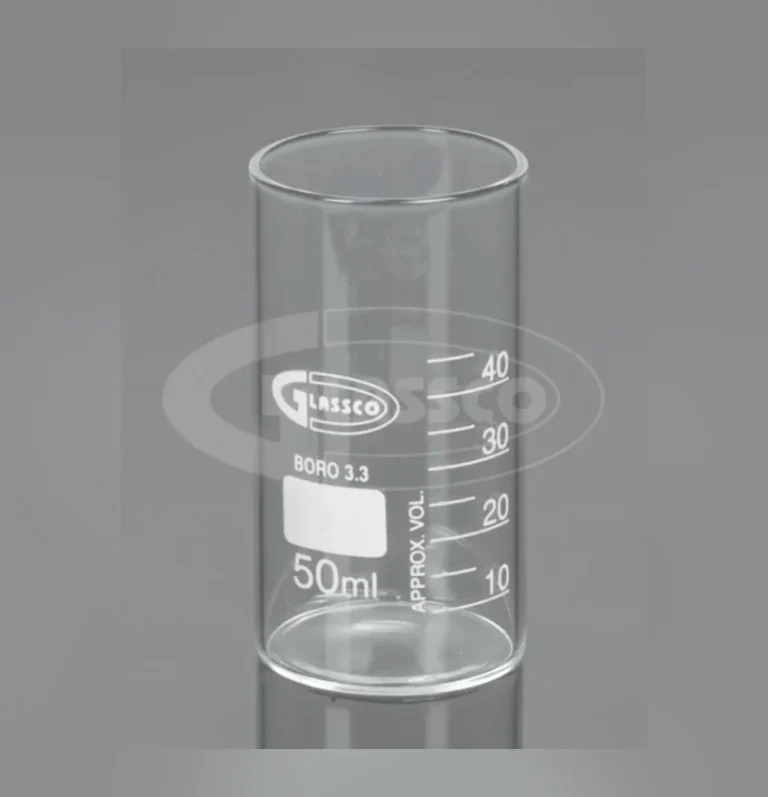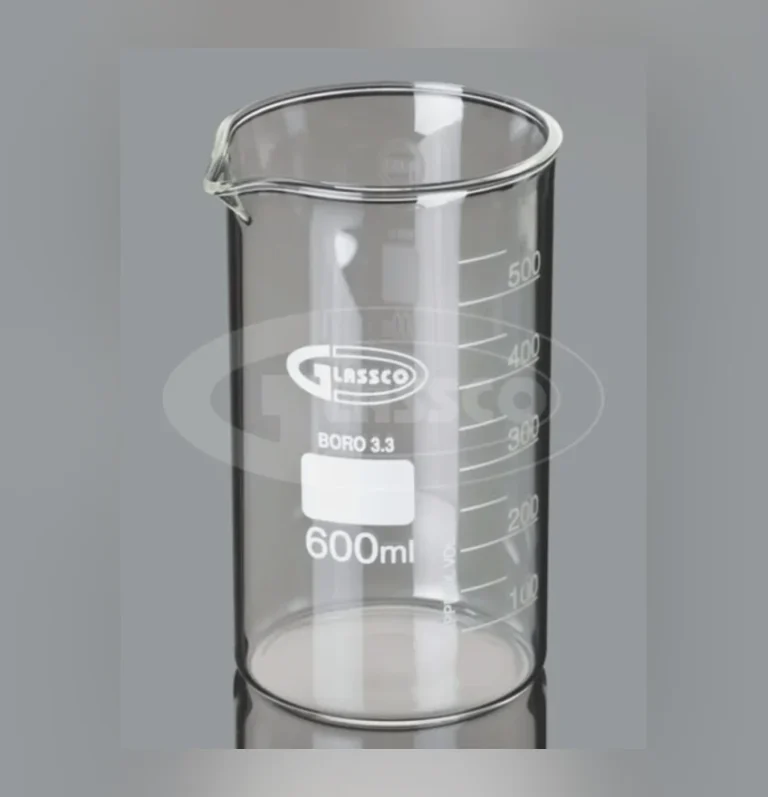
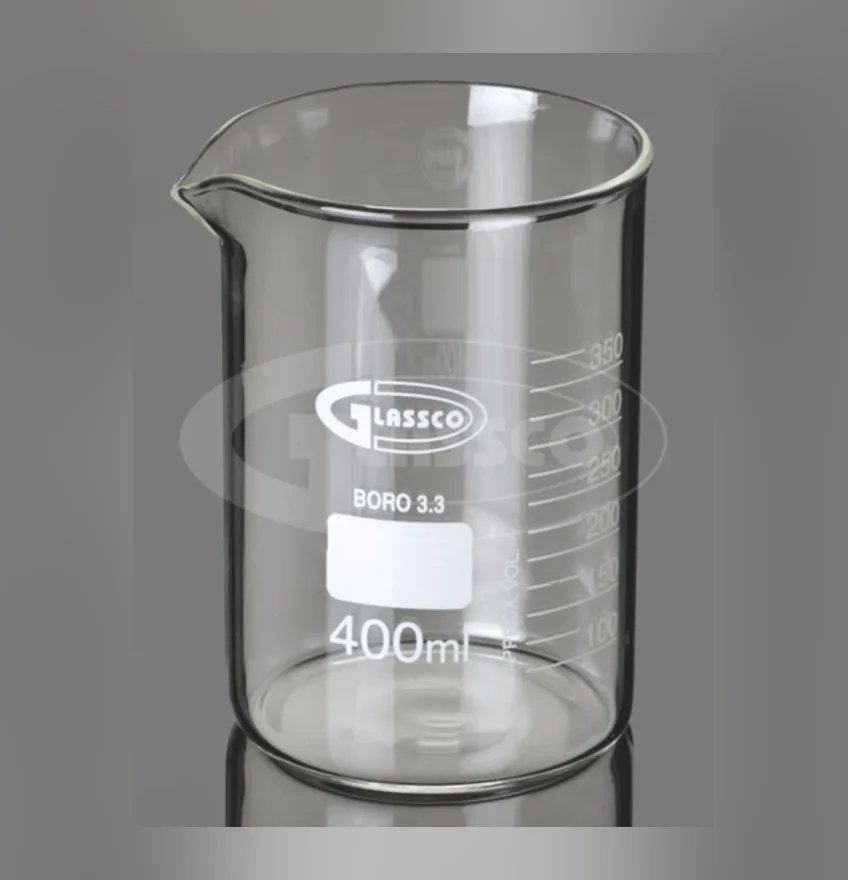
Short answer: a Griffin low form beaker is the general-purpose vessel — wide, shallow, quick to heat and easy to stir. A Berzelius tall form is narrower and roughly twice as tall as it is wide, which cuts evaporation and splashing during titration and boiling.
At 250 ml the difference is real: Griffin is 70 mm across and 95 mm tall, Berzelius is 60 mm across and 120 mm tall.
Beakers are bought by volume and almost never by form, which is why most laboratories end up with one shape doing every job. The two patterns behave differently enough to be worth a minute of thought at the order stage. This guide sits alongside the accuracy class guide — with the same caveat that applies to the conical flask.
A beaker is not a measuring instrument
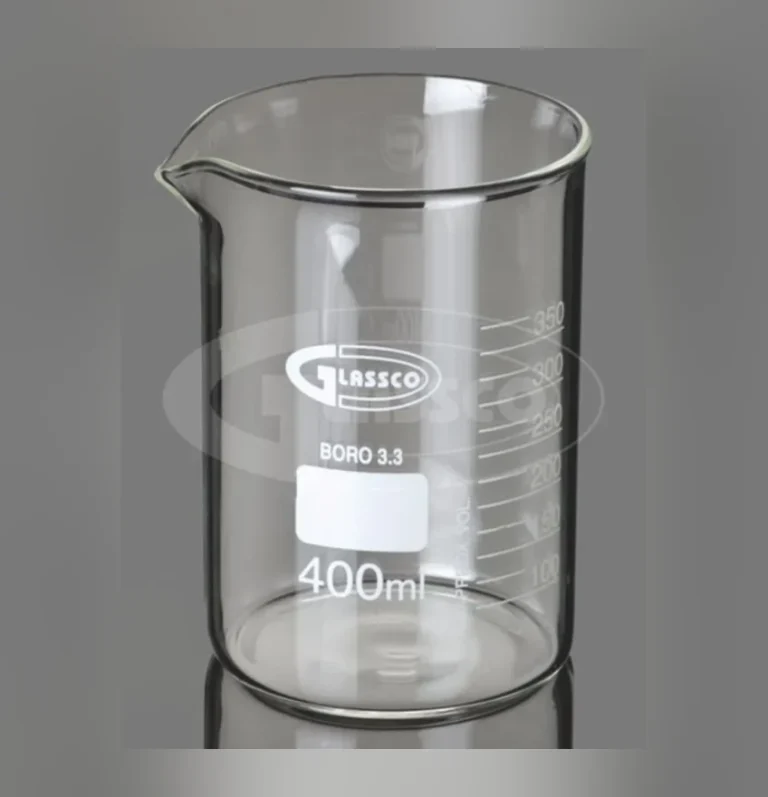
The graduations moulded into a beaker are approximate. They carry no accuracy class, no tolerance and no certificate, and they exist to tell you roughly how much is in the vessel — not to set a volume.
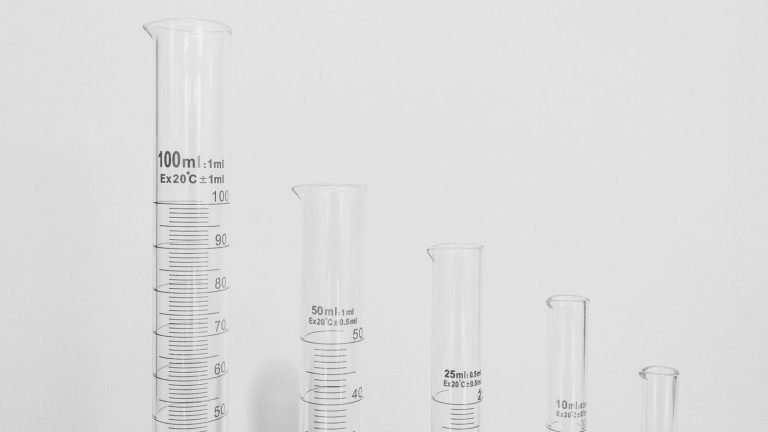
Anything that ends up in a calculation belongs in a volumetric flask, a pipette or, at worst, a measuring cylinder.
The two forms, side by side
| Capacity | Griffin Ø × H | Berzelius Ø × H | Height ÷ diameter |
|---|---|---|---|
| 50 ml | 42 × 58 mm | 38 × 70 mm | 1.38 vs 1.84 |
| 100 ml | 50 × 70 mm | 48 × 80 mm | 1.40 vs 1.67 |
| 250 ml | 70 × 95 mm | 60 × 120 mm | 1.36 vs 2.00 |
| 600 ml | 90 × 125 mm | 80 × 150 mm | 1.39 vs 1.88 |
| 1000 ml | 105 × 157 mm | 90 × 192 mm | 1.50 vs 2.13 |
The pattern is consistent: a Berzelius beaker holds the same volume in a footprint 10 to 15 mm narrower and a body 20 to 35 mm taller. That geometry decides everything else.
- Evaporation is proportional to surface area. The narrower Berzelius loses less over a long heating, which matters when the solution is being concentrated to a defined volume rather than to dryness.
- Splash is harder to produce in a tall vessel, so a Berzelius survives vigorous stirring and boiling with fewer losses.
- Heating rate favours the Griffin: a wider base sits on more of the hotplate and transfers heat faster.
- Access favours the Griffin too. A wide mouth takes a funnel, a spatula and a brush without a fight.
Spout or no spout
The Berzelius pattern is stocked both ways, and the choice is not cosmetic.
With spout — pours cleanly, and the gap under a cover glass lets vapour escape during heating, so the glass does not lift and rattle.
Without spout — takes a cover glass that seals the mouth properly, which is what you want when a digestion has to be held for an hour without losing analyte. It is also the pattern to choose where a beaker is stored covered between steps.
A laboratory doing sample digestion usually wants both: spouted for transfer work, unspouted for anything held under a cover glass.
If the solution will be poured, buy the spout. If it will be covered and heated, buy the one without. Most benches only ever ordered the first and then improvised the second.
PT Praglas Raya technical team
The size range, and what it tells you
The Griffin range runs from 5 ml to 10000 ml across fifteen sizes; Berzelius stops at 1000 ml. That is not an oversight — the tall form exists for controlled heating and titration, and neither is done at ten litres.
Pack sizes track the same logic: 10 per pack up to 400 ml, dropping to 8, 6, 4 and finally 1 as the vessel gets larger. Small beakers are consumables; a 10 litre beaker is a piece of equipment.
When to use plastic instead
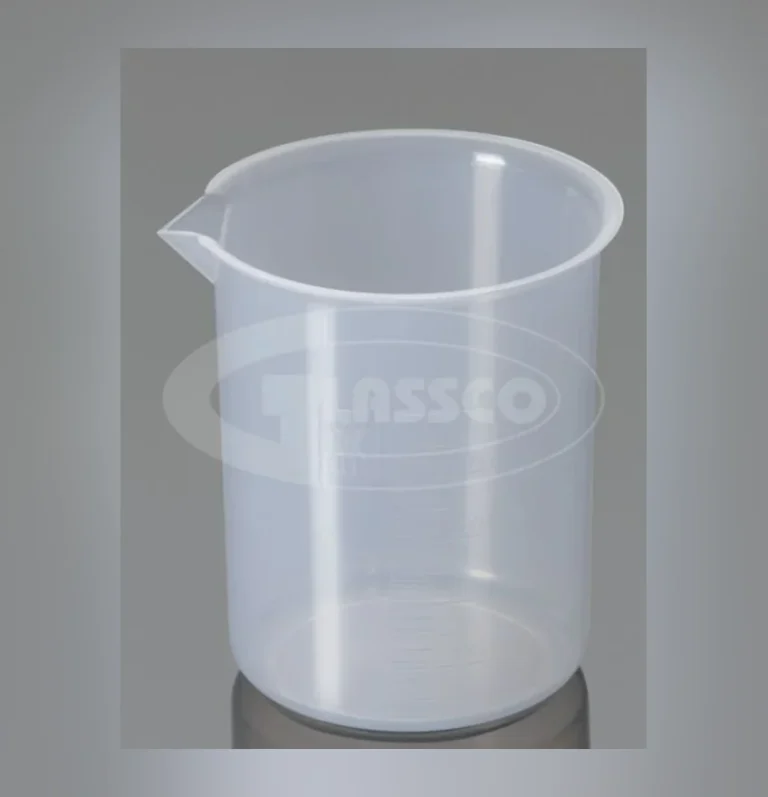
The polypropylene measuring beaker in the range is heat resistant to 120 °C, low form, with a flared beaded top. It wins where glass is a liability:
- Hydrofluoric acid and strong alkali, which attack borosilicate — see the borosilicate guide.
- Fieldwork and teaching, where the vessel will be dropped.
- Rinse, transfer and waste handling, where clarity and inertness do not matter.
It loses on temperature, on clarity and on solvent resistance. Do not put it on a hotplate.
A decision table for procurement
| Job | Pattern | Why |
|---|---|---|
| General dissolving, mixing, transfer | Griffin low form, spouted | Wide mouth, fast heating, easy access |
| Titration in a beaker with a stirrer | Berzelius tall form | Deeper liquid column, less splash |
| Digestion under a cover glass | Berzelius without spout | The cover seats properly |
| Boiling down a solution | Berzelius tall form | Smaller surface, slower evaporation loss |
| Rapid heating on a hotplate | Griffin low form | Wider base, more contact area |
| Alkali, hydrofluoric acid, fieldwork | Polypropylene beaker | Glass is attacked or will break |
Frequently asked questions
What is the difference between a Griffin and a Berzelius beaker?
Proportion. A Griffin low form is roughly 1.4 times as tall as it is wide; a Berzelius tall form is closer to 2.0. At 250 ml that is 70 × 95 mm against 60 × 120 mm for the same volume.
Can I measure volume with a beaker’s graduations?
Only approximately. Beaker graduations carry no accuracy class and no stated tolerance. Use a volumetric flask, a pipette or a measuring cylinder when the number matters.
Which beaker is better for heating?
Griffin for speed, because the wider base takes more heat from the plate. Berzelius for control, because the narrower mouth loses less to evaporation over a long heating.
Why buy a beaker without a spout?
So a cover glass seats flat on the rim. That matters for digestions and for anything held hot for an extended period, where a spouted beaker vents continuously.
Are plastic beakers autoclavable?
The polypropylene beaker in this range is rated to 120 °C, which covers a standard cycle, but check the cycle temperature against the product rating before assuming it. It should never be used on a hotplate or over a flame.
Sources and further reading
- ISO 3585:1998 — Borosilicate glass 3.3: Properties
- ISO 384:2015 — Laboratory glass and plastics ware: Principles of design and construction of volumetric instruments
- ISO 4788:2005 — Laboratory glassware: Graduated measuring cylinders
Dimensions are taken from the GLASSCO specification tables on the product pages of this site. Browse the beaker range and the plasticware range, or talk to our technical team about a pattern for a particular method.