Short answer: use a one-mark volumetric pipette when you need one fixed volume accurately — aliquots for a calibration curve, dilutions that feed a reported result. Use a graduated pipette when you need several different volumes from the same piece of glass and can accept two to three times the error.
At 25 ml the difference is ±0.030 ml against ±0.100 ml: 0.12% versus 0.40% of the delivered volume.
Both patterns are covered by their own standard — ISO 648 for single-volume pipettes, ISO 835 for graduated ones — under the shared design rules of ISO 384. This guide sits under the guide to laboratory glassware accuracy classes, which compares the same class markings across every volumetric instrument.
One mark or many: the trade you are making
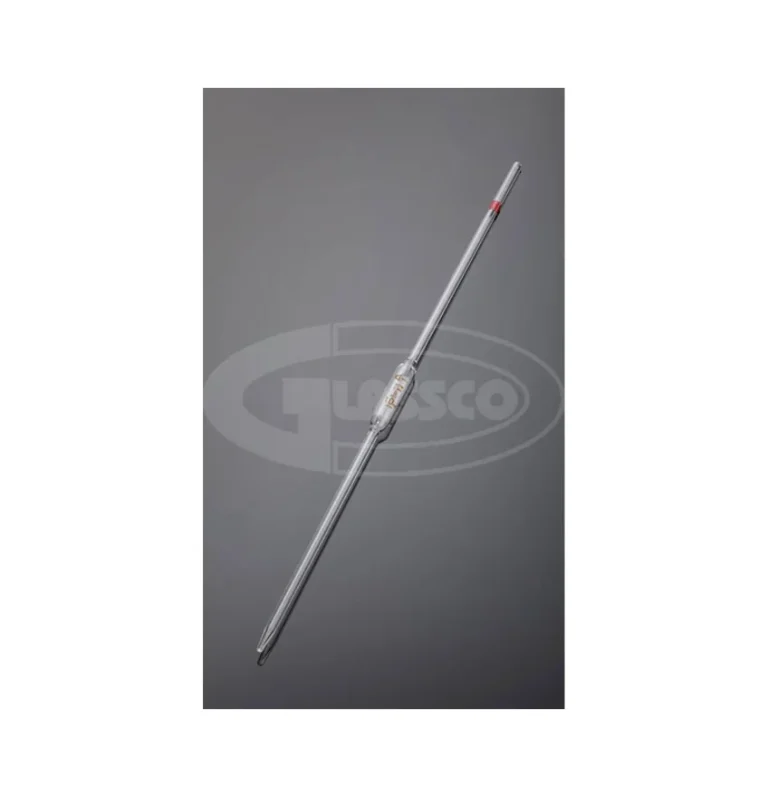
A one-mark pipette has a single graduation on a narrow stem above a bulb. That geometry is why it is accurate: the meniscus sits in a narrow bore, so a small error in liquid height is a very small error in volume. It delivers one volume and nothing else.
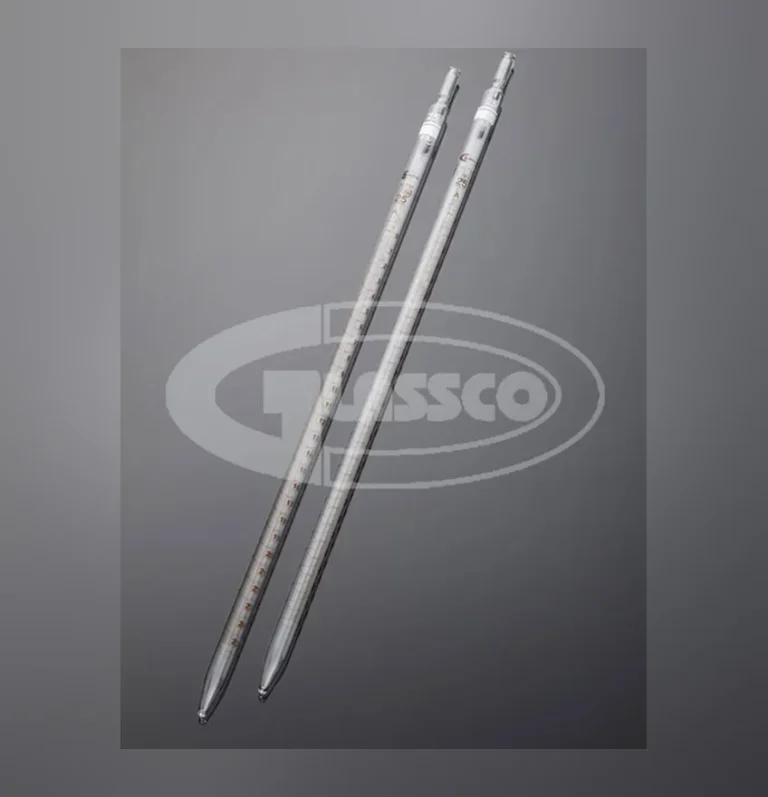
A graduated pipette is a tube of near-constant bore with a scale printed up it. The same liquid height error now spans a much wider cross-section, and the tolerance widens accordingly. In exchange you can deliver 3.7 ml, or 4.2 ml, or anything else on the scale.
Neither is a substitute for the other. The mistake worth avoiding is buying only graduated pipettes because they look more flexible, then using them for standards work.
Tolerance by capacity: the GLASSCO pipette range
The figures below are the published specifications for the pipettes PT Praglas Raya stocks. Relative tolerance is the tolerance as a percentage of the nominal capacity.
| Capacity | Tolerance | Relative | Colour band |
|---|---|---|---|
| 0.5 ml | ±0.005 ml | 1.00% | 2 black |
| 1 ml | ±0.008 ml | 0.80% | Blue |
| 2 ml | ±0.010 ml | 0.50% | Orange |
| 5 ml | ±0.015 ml | 0.30% | White |
| 10 ml | ±0.020 ml | 0.20% | Red |
| 20 ml | ±0.030 ml | 0.15% | Yellow |
| 25 ml | ±0.030 ml | 0.12% | Blue |
| 50 ml | ±0.050 ml | 0.10% | Red |
| 100 ml | ±0.080 ml | 0.08% | Yellow |
| Capacity | Subdivision | Tolerance | Relative | Colour code |
|---|---|---|---|---|
| 0.1 ml | 0.01 ml | ±0.006 ml | 6.00% | White |
| 0.2 ml | 0.01 ml | ±0.006 ml | 3.00% | Black |
| 1 ml | 0.01 / 0.10 ml | ±0.007 ml | 0.70% | Yellow / red |
| 2 ml | 0.02 / 0.10 ml | ±0.010 ml | 0.50% | Black / green |
| 5 ml | 0.05 / 0.10 ml | ±0.030 ml | 0.60% | Red / blue |
| 10 ml | 0.10 ml | ±0.050 ml | 0.50% | Orange |
| 25 ml | 0.10 ml | ±0.100 ml | 0.40% | White |
The two ranges compared
| Volume | One-mark | Graduated | Graduated is looser by |
|---|---|---|---|
| 1 ml | ±0.008 ml | ±0.007 ml | — |
| 2 ml | ±0.010 ml | ±0.010 ml | — |
| 5 ml | ±0.015 ml | ±0.030 ml | 2.0× |
| 10 ml | ±0.020 ml | ±0.050 ml | 2.5× |
| 25 ml | ±0.030 ml | ±0.100 ml | 3.3× |
Below 2 ml the two are effectively equal, because at that size both are narrow-bore tubes. The gap opens above 5 ml and keeps widening — which is exactly the range where most aliquots are taken.
Where the small sizes fail
A 0.1 ml graduated pipette carries ±0.006 ml. That is 6% of its nominal capacity, and it is the worst relative figure anywhere in the volumetric range — worse than the smallest measuring cylinder, worse than the smallest volumetric flask.
If a method needs 0.1 ml delivered accurately, glass is the wrong instrument. A calibrated air-displacement micropipette is built for that range. Glass takes over from roughly 1 ml upwards, where its stability and chemical resistance start to matter more than its resolution.
Class AS, and why it appears on pipettes
Like burettes, draining pipettes carry the AS designation: the same tolerance as Class A, plus a specified delivery time and waiting period before the tip is withdrawn. The wait exists because the film of liquid clinging to the wall keeps draining after the bulk has gone.
Two consequences follow for daily use:
- Do not blow out a one-mark pipette. It is calibrated to deliver with the residual drop left in the jet. Forcing that drop out adds volume the calibration never intended.
- Touch the jet to the wall of the receiving vessel after delivery, and hold it there for the specified wait. Lifting early leaves part of the aliquot in the pipette.
Two analysts, one pipette, two different techniques for the last drop — that is the single most common source of an unexplained bias between operators that we get asked about.
PT Praglas Raya technical team
Colour bands are a stock-control tool
Every pipette in both ranges carries a colour band coded to capacity. In a drawer of wet glassware the band is readable when the printed figures are not, and it is the fastest way to spot a 20 ml pipette that has drifted into the 25 ml rack.
The codes repeat between the two ranges — blue is 1 ml on a one-mark pipette and 5 ml on a graduated one — so the code identifies capacity within a range, not across ranges. Store the two patterns separately.
A decision table for procurement
| Application | Pattern | Class |
|---|---|---|
| Aliquot for a calibration curve or standard | One-mark | AS |
| Fixed dilution repeated every day | One-mark at the exact volume | AS |
| Method development, variable volumes | Graduated | AS |
| Adding reagent to a reaction, volume not critical | Graduated | B is defensible |
| Serial dilutions in microbiology | Graduated, serological pattern | AS |
| Anything below 1 ml that is reported | Not glass — use a micropipette | — |
Frequently asked questions
Which is more accurate, a volumetric or a graduated pipette?
The one-mark volumetric pipette, by a factor of two to three above 5 ml. At 25 ml it holds ±0.030 ml against ±0.100 ml for a graduated pipette of the same capacity. Below 2 ml the two are comparable.
Should I blow out the last drop in a pipette?
Not on a one-mark volumetric pipette — it is calibrated to deliver with that drop retained, and blowing it out overdelivers. Blow-out is only correct on pipettes explicitly marked for it, which carry a frosted or double band at the top.
What do the colour bands on pipettes mean?
They code the capacity so it can be read at a glance. The code is specific to a pattern: blue means 1 ml on the one-mark range and 5 ml on the graduated range, so the two patterns should not be stored together.
Why does the same graduated pipette come in two subdivisions?
A 1 ml pipette divided in 0.01 ml steps and one divided in 0.10 ml steps hold the same ±0.007 ml tolerance — the finer scale improves how precisely you can read an intermediate volume, not how accurately the glass was made. Buy the fine division when you routinely deliver part-volumes, the coarse one when you mostly deliver the full capacity.
Can a graduated pipette be used for a pharmacopoeial assay?
Only where the method’s acceptance limit is wide enough to absorb 0.4 to 0.6% from the glassware alone, and where that judgement is written down. Steps described as accurately measured should use a one-mark pipette of the right capacity.
Sources and further reading
- ISO 648:2008 — Laboratory glassware: Single-volume pipettes
- ISO 835:2007 — Laboratory glassware: Graduated pipettes
- ISO 384:2015 — Laboratory glass and plastics ware: Principles of design and construction of volumetric instruments
- ISO 4787:2021 — Laboratory glass and plastic ware: Volumetric instruments, methods for testing of capacity and for use
- USP–NF General Chapter <31> — Volumetric Apparatus
Specification figures are taken from the GLASSCO pipette range stocked by PT Praglas Raya. Browse all pipettes, read the accuracy class guide, or talk to our technical team about specifying for a particular method.