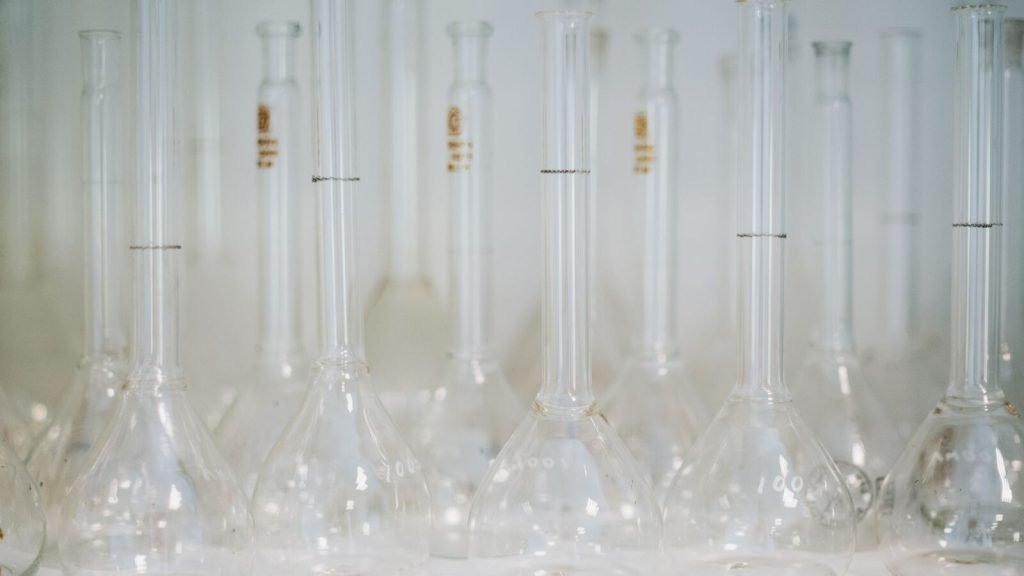
Short answer: use Class A when the flask’s own error must stay below roughly one tenth of your method’s acceptance limit — analytical standards, pharmacopoeial assays, calibration curves and anything that carries a certificate. Class B, whose tolerance is exactly twice as wide, is sufficient for reagent make-up, buffers, rinse solutions and teaching work.
On a 100 ml flask that difference is ±0.100 ml versus ±0.200 ml — 0.10% against 0.20% of nominal volume.
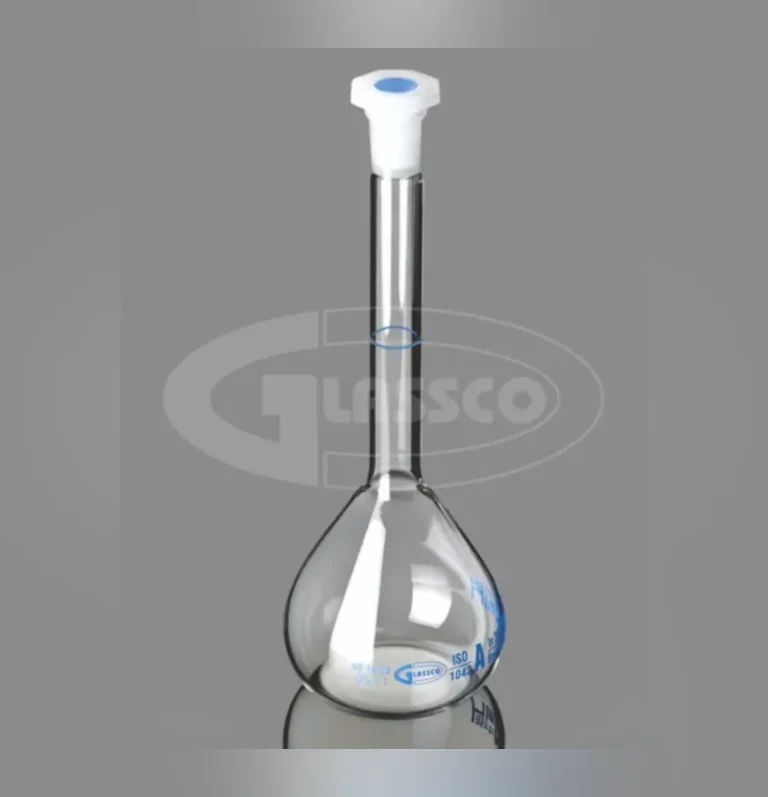
Volumetric flask tolerance is set by ISO 1042 (one-mark volumetric flasks), with the general design rules in ISO 384 and the equivalent US specification in ASTM E288. All three define two accuracy classes, and in every one of them the Class B limit is twice the Class A limit for the same nominal capacity.
That single relationship is the whole decision. Everything below is about working out which side of it your method sits on.
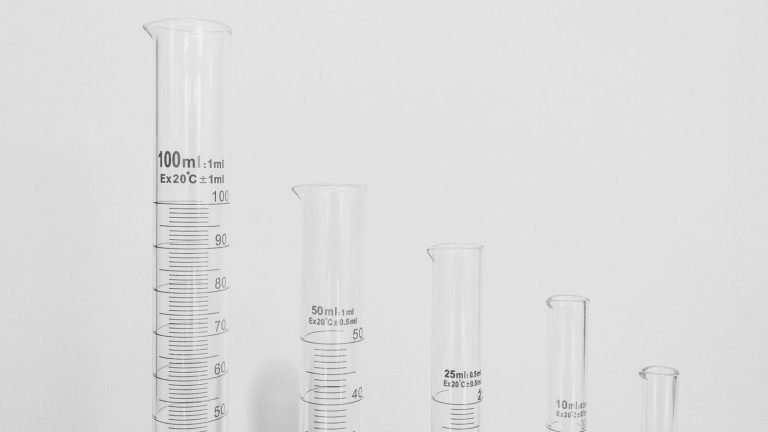
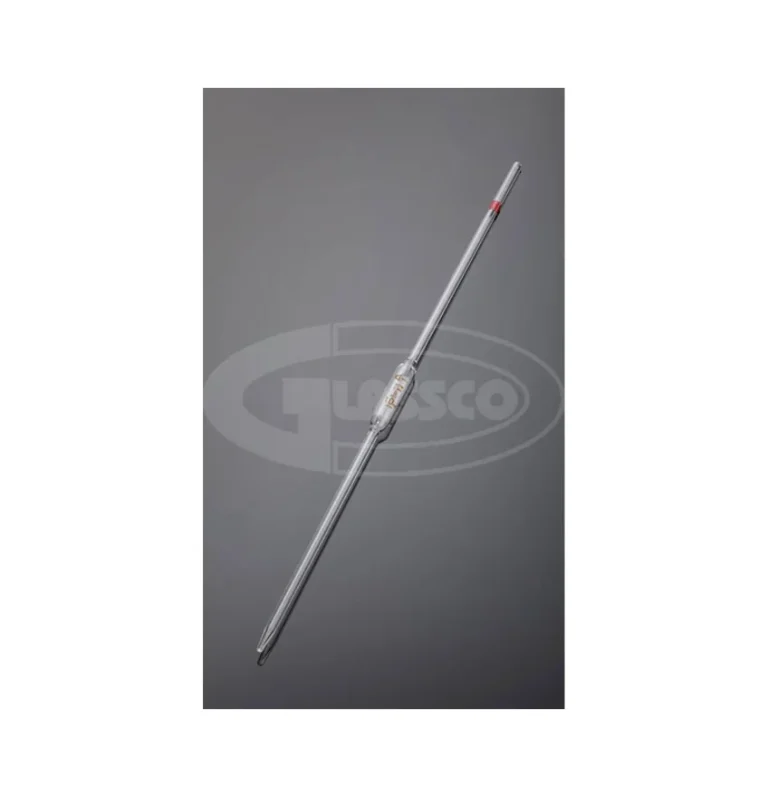
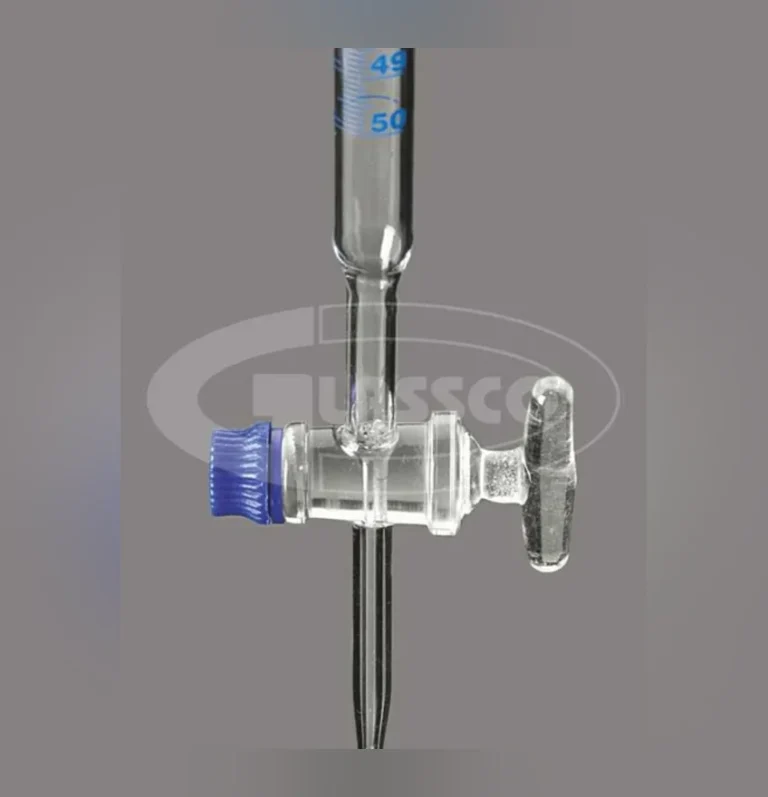
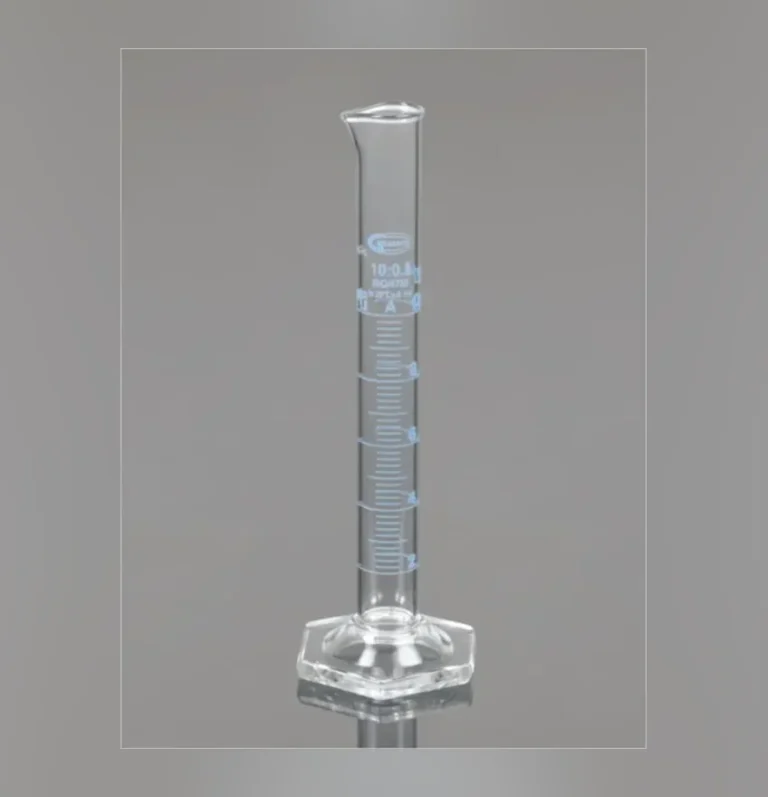
The same class system runs across the whole volumetric range. For how flasks compare with burettes, pipettes and cylinders, see the guide to laboratory glassware accuracy classes.
What the class actually guarantees
A class is a statement about the position of the graduation mark relative to the true volume at the reference temperature of 20 °C. It says nothing about how carefully the flask is used.
Three things sit underneath that guarantee:
- Glass composition. Borosilicate 3.3 to ISO 3585 has a linear expansion coefficient of 3.3 × 10⁻⁶ K-1, roughly a third that of soda-lime glass. Less thermal movement means the calibration holds across normal laboratory temperature swings.
- Mark placement. Class A flasks are individually adjusted; Class B are made to a batch tolerance.
- Documentation. Class A glassware is normally supplied with a batch certificate traceable to a national standard. Class B usually is not.
The practical consequence: if an auditor can ask “how do you know this flask reads 100.0 ml?”, you need Class A and the paperwork behind it.
Tolerance by capacity: the numbers that matter
The table below is the actual specification for the GLASSCO Class A one-mark volumetric flask range that PT Praglas Raya stocks. The right-hand column is the tolerance expressed as a percentage of nominal volume — the figure that decides whether the flask is fit for your method.
| Item code | Capacity (ml) | Neck joint (N/S) | Class A tolerance (±ml) | Relative tolerance |
|---|---|---|---|---|
| 130.202.01 | 5 | 10/19 | 0.040 | 0.80% |
| 130.202.02 | 10 | 10/19 | 0.040 | 0.40% |
| 130.202.02A | 20 | 10/19 | 0.040 | 0.20% |
| 130.202.03 | 25 | 10/19 | 0.040 | 0.16% |
| 130.202.04 | 50 | 12/21 | 0.060 | 0.12% |
| 130.202.05 | 100 | 14/23 | 0.100 | 0.10% |
| 130.202.06 | 200 | 14/23 | 0.150 | 0.075% |
| 130.202.07 | 250 | 14/23 | 0.150 | 0.060% |
| 130.202.08 | 500 | 19/26 | 0.250 | 0.050% |
| 130.202.09 | 1000 | 24/29 | 0.400 | 0.040% |
| 130.202.10 | 2000 | 29/32 | 0.600 | 0.030% |
| 130.202.11 | 5000 | 34/35 | 1.200 | 0.024% |
Read down that last column and the important pattern appears: relative accuracy improves by a factor of about 33 from the 5 ml flask to the 5000 ml flask, from 0.80% down to 0.024%.
Small flasks are the weak link, not the large ones. A 5 ml Class B flask carries ±0.080 ml — 1.6% of nominal volume. Put that at the start of a dilution series and no downstream instrument precision will recover it.
The rule of thumb worth remembering
Below 25 ml, specify Class A almost regardless of application. Above 500 ml, the class rarely dominates the error budget, and pipetting technique or temperature control will matter more.
The same two-class split runs through the rest of the volumetric range. Volumetric pipettes, burettes and measuring cylinders are all specified against the same ISO framework, and in each of them the Class B limit is twice the Class A limit for the same nominal capacity.
A decision table for procurement
| Application | Recommended class | Why |
|---|---|---|
| Primary and secondary analytical standards | Class A | The flask error propagates into every sample measured against the standard |
| Pharmacopoeial assay preparation | Class A | USP General Chapter <31> requires volumetric apparatus of certified accuracy |
| Calibration curve dilutions | Class A | Compounding tolerance across a series magnifies any single flask error |
| Certificate of analysis work | Class A | Traceable documentation is part of the deliverable |
| Buffer and reagent make-up | Class B | Concentration is verified downstream, typically by titration or pH |
| Mobile phase preparation | Class B | Retention time shifts are corrected by the chromatographic method itself |
| Rinse and stock solutions | Class B | No accuracy requirement attaches to the volume |
| Undergraduate teaching laboratories | Class B | Breakage rates make the cost difference the deciding factor |
Do not overlook the neck joint
The N/S column in the specification table is the standard ground-glass joint size, and it is the single most common ordering mistake we see.
Two 50 ml flasks in the same range carry different joints — 12/21 on item 130.202.04 and 14/23 on 130.202.04B — and the same split appears at 100 ml. A stopper bought against the wrong joint will not seal, and a flask ordered without checking will not accept the stoppers already in the laboratory.
Order the flask and its closure together, or confirm the joint size against what is already on the bench. Every item in our laboratory flask range lists its joint size in the specification table on the product page.
Verifying a flask you already own
ISO 4787 sets out the gravimetric method for testing the capacity of volumetric glassware, and it is well within the reach of any laboratory with a four-place balance.
The procedure in outline:
- Clean and dry the flask, then weigh it empty.
- Fill to the mark with distilled water equilibrated to room temperature, reading the bottom of the meniscus at eye level.
- Weigh again and take the difference.
- Convert mass to volume using the density of water at the measured temperature, applying the buoyancy correction that ISO 4787 specifies.
- Compare the result against the tolerance for that capacity and class.
Two points that catch people out. Volumetric glassware is calibrated to contain (marked In), not to deliver — a flask drained into a beaker does not transfer its nominal volume. And Class A glassware does not hold its certification indefinitely: etching from strong alkali, repeated autoclaving and thermal shock all shift the mark’s effective position over time.
Most tolerance problems we are asked to investigate are not manufacturing faults. They are Class B flasks doing Class A work, or Class A flasks that have spent two years in a dishwasher with caustic detergent.
PT Praglas Raya technical team
Frequently asked questions
What is the difference between Class A and Class B volumetric flasks?
Class B flasks have exactly twice the volumetric tolerance of Class A flasks of the same capacity, as defined in ISO 1042 and ASTM E288. A 100 ml Class A flask is held to ±0.100 ml; the Class B equivalent is ±0.200 ml. Class A flasks are individually adjusted and normally supplied with a traceable batch certificate.
Do volumetric flasks need recalibration?
Borosilicate 3.3 glassware does not drift on its own, but the mark’s effective position changes if the glass surface is attacked. Laboratories under ISO/IEC 17025 typically re-verify Class A flasks on a defined interval using the gravimetric method in ISO 4787, and immediately after any exposure to strong alkali, hydrofluoric acid or thermal shock.
Can I use a Class B flask to prepare an analytical standard?
Not where the result is reported or audited. At 100 ml the Class B tolerance of ±0.200 ml is 0.20% of nominal volume, which consumes a large share of the error budget in most assays before any other source of uncertainty is counted.
Why do two flasks of the same volume have different neck joint sizes?
Joint size is specified independently of capacity so that flasks can match existing stoppers, condensers and other jointed apparatus. In the GLASSCO Class A range, 50 ml flasks are available with 12/21 and 14/23 joints, and 100 ml with 12/21 and 14/23. Always confirm the N/S figure when ordering.
What does “Boro 3.3” mean on a laboratory flask?
It identifies borosilicate glass 3.3 to ISO 3585, named for its linear thermal expansion coefficient of 3.3 × 10⁻⁶ K-1. The low expansion gives the glass its resistance to thermal shock and its chemical durability against water, acids and neutral salt solutions.
Sources and further reading
- ISO 1042:1998 — Laboratory glassware: One-mark volumetric flasks
- ISO 384:2015 — Laboratory glass and plastics ware: Principles of design and construction of volumetric instruments
- ISO 4787:2021 — Laboratory glass and plastic ware: Volumetric instruments, methods for testing of capacity and for use
- ISO 3585:1998 — Borosilicate glass 3.3: Properties
- ASTM E288-10(2017) — Standard Specification for Laboratory Glass Volumetric Flasks
- USP–NF General Chapter <31> — Volumetric Apparatus
Specification figures in this article are taken from the GLASSCO Class A one-mark volumetric flask range stocked by PT Praglas Raya. Browse the full catalogue of 143 laboratory products or talk to our technical team about specifying for a particular method.