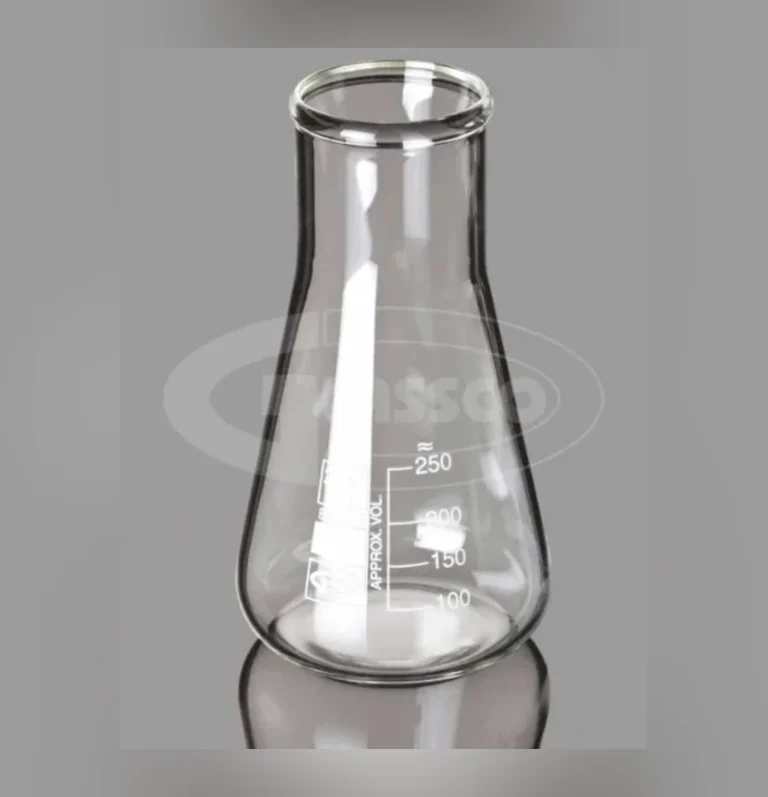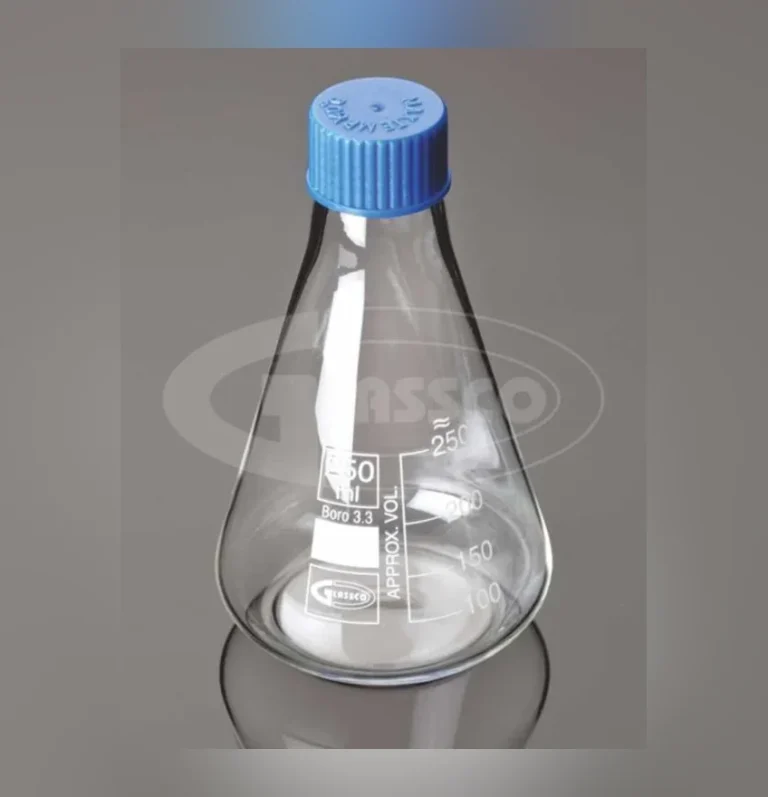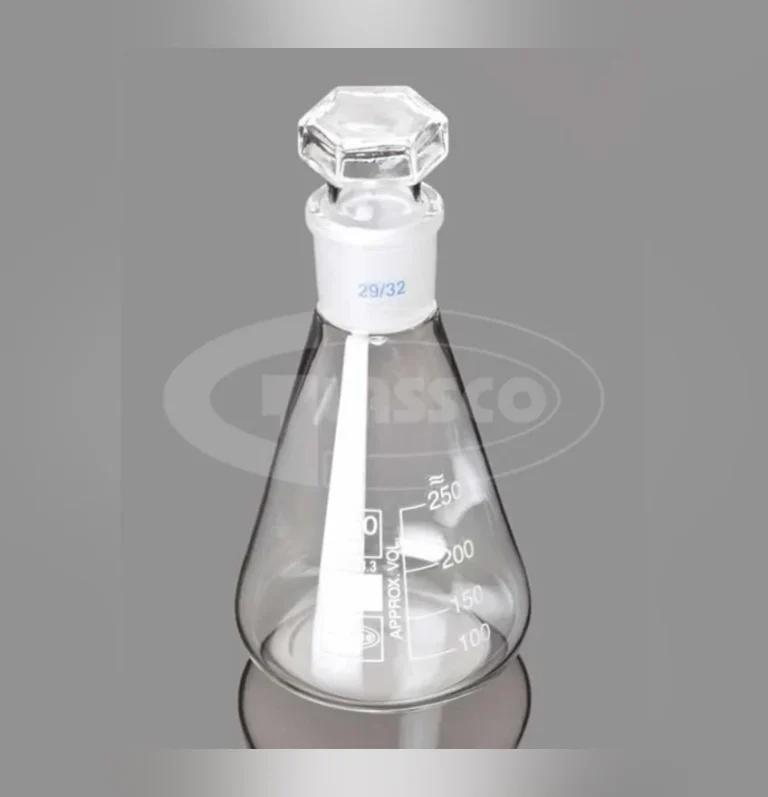
Short answer: pick the neck, not the flask. A narrow neck holds vapour in and lets you swirl hard without splashing — the default for titration. A wide neck takes solids, a funnel and a cleaning brush. A screw cap is for storage and shaking, and a ground stopper is for volatile solvents and standards.
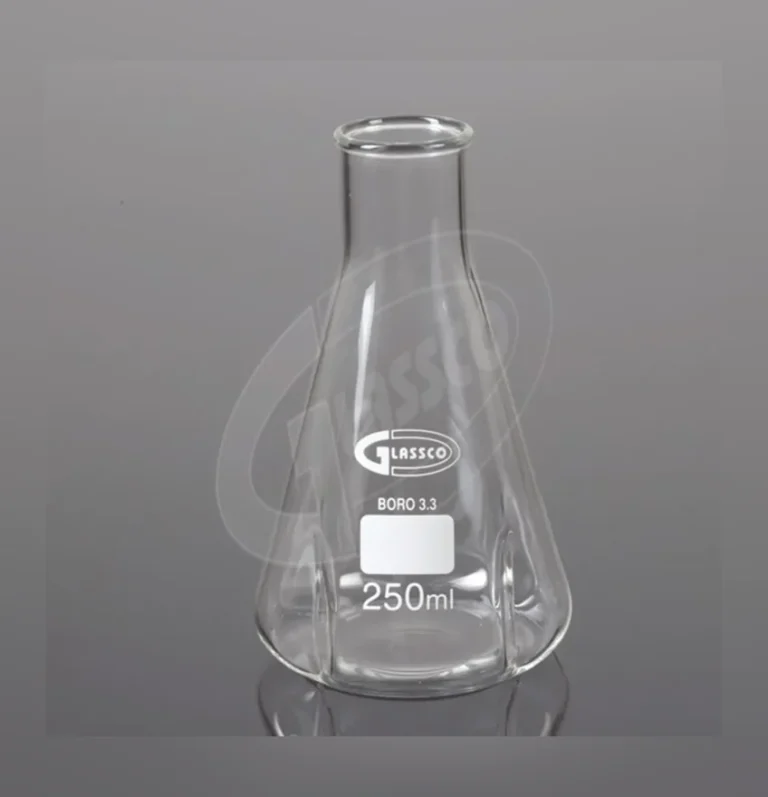
At 250 ml the neck bore is 34 mm narrow against 50 mm wide. That is the whole decision, and it is not on the capacity line of the order.
The conical flask is the least specified piece of glass in most laboratories: it is ordered by volume and by nothing else. Yet the range stocked here offers four distinct patterns at most capacities, and they behave differently enough that the wrong one costs either sample or time. This guide sits alongside the accuracy class guide — with one difference worth stating up front.
A conical flask is not a measuring instrument
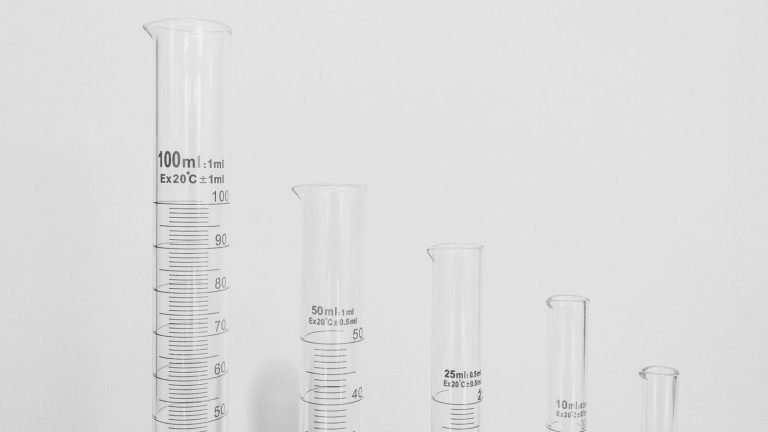
The graduations moulded into an Erlenmeyer are approximate. They carry no accuracy class, no certificate and no tolerance in the specification table, because the flask is a reaction and titration vessel, not a volumetric one.
Use it to hold, mix, heat and titrate. When the volume itself has to be right, transfer from a volumetric flask or deliver with a pipette. The same caveat applies to the beaker range.
Narrow neck against wide neck
Both patterns share the same body diameter at every capacity. Only the neck changes.
| Capacity | Body Ø | Neck Ø narrow | Neck Ø wide | Height |
|---|---|---|---|---|
| 50 ml | 51 mm | 22 mm | 34 mm | 85–90 mm |
| 100 ml | 64 mm | 22 mm | 34 mm | 105 mm |
| 250 ml | 85 mm | 34 mm | 50 mm | 140–145 mm |
| 500 ml | 105 mm | 34 mm | 50 mm | 175–180 mm |
| 1000 ml | 131 mm | 42 mm | 50 mm | 220 mm |
| 2000 ml | 166 mm | 50 mm | 76 mm | 276–280 mm |
At 100 ml the wide neck is more than half again the bore of the narrow one, and at 250 ml the gap is 16 mm. What that buys and costs:
- Narrow neck — less evaporation over a long titration, less splash when swirling vigorously, a smaller target for airborne contamination, and a neck that accepts a standard stopper. Harder to fill with solids, harder to clean.
- Wide neck — a funnel drops in, powders go in without a spatula gymnastics routine, a brush reaches the shoulder, and a culture gets more gas exchange. Evaporates faster and splashes sooner.
The narrow neck range also runs further: it is stocked from 25 ml to 5000 ml, where the wide neck stops at 2000 ml.
The two closed patterns
Where the flask has to be closed, there are two ways to do it, and they are not interchangeable.
| Capacity | Screw thread | Ground joint |
|---|---|---|
| 50 ml | GL 25 | — |
| 100 ml | GL 25 | 24/29 or 29/32 |
| 150 ml | GL 25 | — |
| 250 ml | GL 45 | 29/32 |
| 500 ml | GL 45 | 24/29 or 29/32 |
| 1000 ml | GL 45 | 29/32 |
| 2000 ml | GL 45 | 29/32 |
| 5000 ml | GL 45 | — |
Screw cap (GL 25 or GL 45). A polypropylene cap with a liner. It survives being dropped, seals well enough for transport and shaking, needs no grease, and cannot seize. It is not a vacuum closure, and the cap is the temperature limit — remove it before autoclaving or heating.
Ground stopper (24/29 or 29/32). Glass on glass, so the closure has the same chemical resistance as the flask and contributes nothing to the sample. Right for volatile solvents, for standards held overnight, and for anything where a plastic liner would be a contamination path. It will seize if alkali is left in it — see the guide to ground glass joints.
Note the split at 100 ml and 500 ml: both are stocked with two different joint sizes. Check the marking before ordering a replacement stopper.
If the flask will be carried, use a screw cap. If it will be measured from, use a ground stopper. If someone will autoclave it, buy both and keep the cap out of the chamber.
PT Praglas Raya technical team
Sizing the flask to the job
A conical flask works because its shape lets liquid swirl without leaving the vessel. That only holds while the flask is part empty.
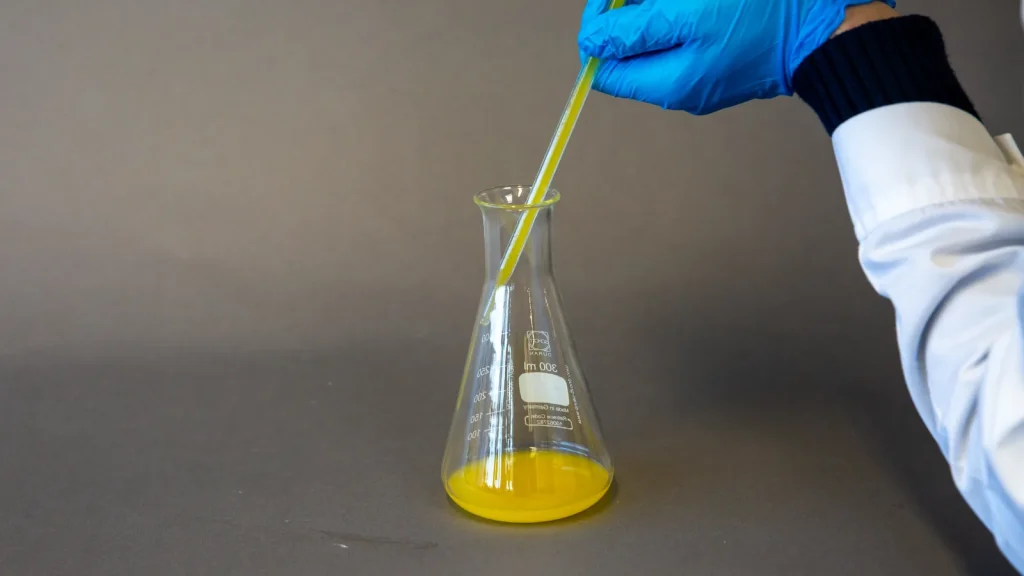
- Titration — fill to roughly a third. A 250 ml narrow-neck flask is the standard choice for a titre of 20 to 50 ml, and leaves room to swirl at the endpoint.
- Heating or boiling — half full at most, and never with the neck closed.
- Culture and shaking — a fifth to a quarter, in a wide neck, so the surface keeps moving and gas exchange continues.
- Storage — as full as practical, in a closed pattern, to limit headspace and evaporation.
Pack sizes tell you the intent
The plain narrow and wide neck flasks are supplied in packs of 10 down to 1000 ml. The screw-cap and stoppered patterns come in packs of 2. That difference is not arbitrary: plain conical flasks are consumables that break and get replaced in quantity, while closed patterns are bought for a specific task and kept.
Budget accordingly — a teaching laboratory ordering 40 titration flasks and a QC laboratory ordering 2 stoppered flasks for standards are buying two different things.
Frequently asked questions
What is the difference between a narrow neck and wide neck Erlenmeyer flask?
Only the neck bore — the body is identical. At 250 ml the narrow neck is 34 mm and the wide neck 50 mm. Narrow necks lose less to evaporation and splash less when swirled; wide necks are easier to fill, clean and aerate.
Can I measure volume with the graduations on a conical flask?
Only approximately. Those marks carry no accuracy class and no tolerance. For a volume that enters a calculation, use a volumetric flask or a pipette.
Which flask size should I use for titration?
A 250 ml narrow-neck flask suits most titrations with a titre in the 20 to 50 ml range, leaving the flask about a third full so it can be swirled hard without loss.
Should I choose a screw cap or a ground glass stopper?
Screw cap for transport, shaking and routine storage — it will not seize and survives handling. Ground stopper for volatile solvents, for analytical standards, and wherever a plastic cap liner would contaminate the sample.
Can conical flasks be autoclaved?
Yes, in borosilicate 3.3, with the closure removed or loosened and any plastic cap taken out of the chamber. Cool in the autoclave rather than in room air. See the borosilicate guide for what repeated cycling does to printed scales.
Sources and further reading
- ISO 3585:1998 — Borosilicate glass 3.3: Properties
- ISO 383:1976 — Laboratory glassware: Interchangeable conical ground joints
- ISO 4797:2015 — Laboratory glassware: Boiling flasks with conical ground joints
- ISO 384:2015 — Laboratory glass and plastics ware: Principles of design and construction of volumetric instruments
Dimensions are taken from the GLASSCO specification tables on the product pages of this site. Browse the conical flask range, read the accuracy class guide, or talk to our technical team about a pattern for a particular method.