Short answer: a Class A measuring cylinder holds exactly half the tolerance of a Class B one — ±0.50 ml against ±1.00 ml at 100 ml — and normally arrives with a batch certificate. Buy Class A when the volume is recorded, reported or audited. Buy Class B for reagent make-up, rinsing and anything where the number never leaves the bench.
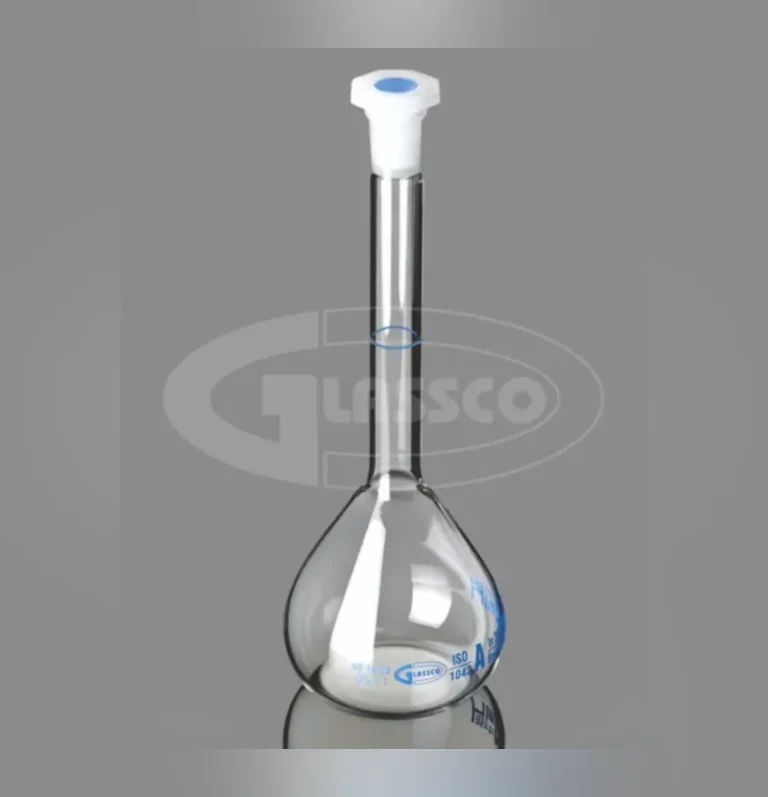
Before choosing either, check that a cylinder is the right instrument at all. A Class A cylinder at 100 ml is five times looser than a Class A volumetric flask at the same volume.
Measuring cylinder classes are defined by ISO 4788, under the general design rules of ISO 384. This guide sits under the site’s guide to laboratory glassware accuracy classes, which compares the same markings across flasks, burettes and pipettes.
Tolerance by capacity: the GLASSCO cylinder range
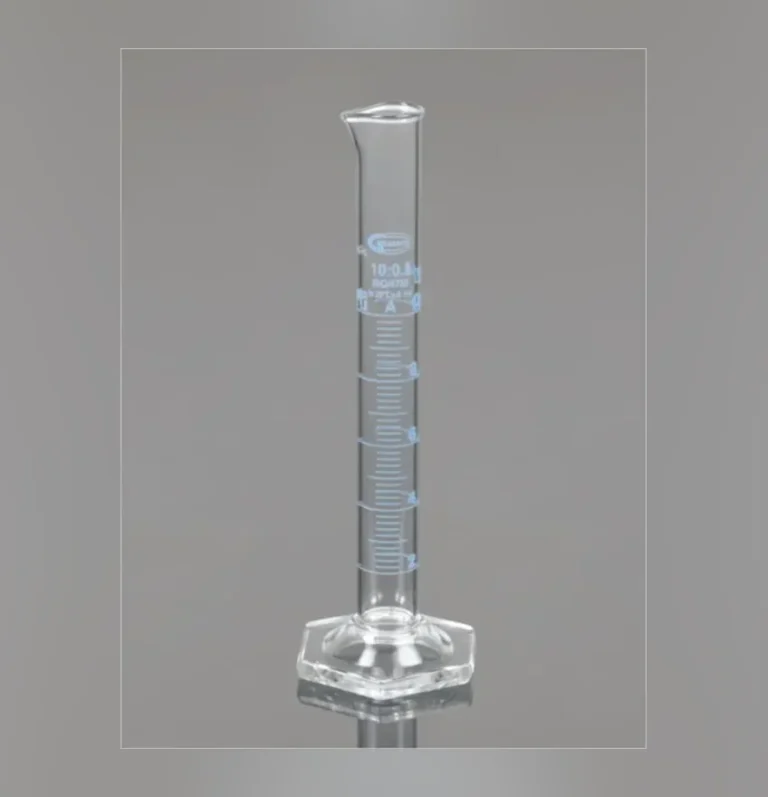
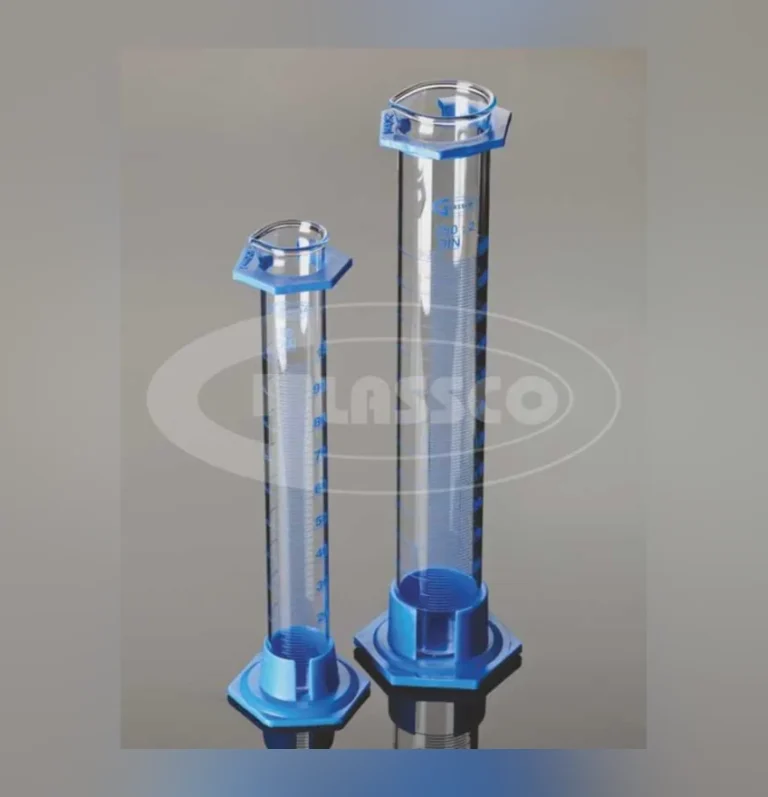
The figures below are the published specifications for the two ranges PT Praglas Raya stocks — the Class A hexagonal-base cylinder supplied with a batch certificate, and the Class B cylinder with a detachable PE base and protection collar.
| Capacity | Subdivision | Class A | Relative | Class B | Relative |
|---|---|---|---|---|---|
| 5 ml | 0.1 ml | ±0.05 ml | 1.00% | ±0.10 ml | 2.00% |
| 10 ml | 0.2 ml | ±0.10 ml | 1.00% | ±0.20 ml | 2.00% |
| 25 ml | 0.5 ml | ±0.25 ml | 1.00% | ±0.50 ml | 2.00% |
| 50 ml | 1.0 ml | ±0.50 ml | 1.00% | ±1.00 ml | 2.00% |
| 100 ml | 1.0 ml | ±0.50 ml | 0.50% | ±1.00 ml | 1.00% |
| 250 ml | 2.0 ml | ±1.00 ml | 0.40% | ±2.00 ml | 0.80% |
| 500 ml | 5.0 ml | ±2.50 ml | 0.50% | ±5.00 ml | 1.00% |
| 1000 ml | 10.0 ml | ±5.00 ml | 0.50% | ±10.00 ml | 1.00% |
| 2000 ml | 20.0 ml | ±10.00 ml | 0.50% | — | — |
The Class B column is twice the Class A column on every row, which is the ISO relationship holding as it does across all volumetric glassware. What is more interesting is the relative column: every cylinder at 50 ml and below carries a full 1% error at Class A, and 2% at Class B. The relative accuracy does not improve as the cylinder gets smaller — it gets worse, then flattens.
How a cylinder compares with a flask
This is the comparison that decides most procurement questions, and it is rarely put side by side.
| Volume | Cylinder, Class A | Flask, Class A | Cylinder is looser by |
|---|---|---|---|
| 25 ml | ±0.25 ml | ±0.040 ml | 6.3× |
| 100 ml | ±0.50 ml | ±0.100 ml | 5.0× |
| 250 ml | ±1.00 ml | ±0.150 ml | 6.7× |
| 500 ml | ±2.50 ml | ±0.250 ml | 10.0× |
| 1000 ml | ±5.00 ml | ±0.400 ml | 12.5× |
A Class B flask beats a Class A cylinder at every one of those volumes, and usually costs less. The reason is geometric: a single graduation ring on a narrow neck can be placed and read to a fraction of a millimetre of liquid height, while a scale printed up a wide barrel cannot.
So the first question is not which class of cylinder to buy. It is whether the volume you are measuring should be measured in a cylinder at all — and if the answer is that the number never leaves the bench, a beaker is cheaper and just as suitable.
If the volume ends up in a calculation, use a flask or a pipette. If it ends up in a beaker, use a cylinder. Most of the accuracy complaints we investigate come from that line being crossed.
PT Praglas Raya technical team
When the batch certificate is worth paying for
The Class A hexagonal-base cylinder is supplied with a batch certificate: a statement that a sample from the production batch was verified against a traceable standard. That document, not the tolerance alone, is usually what an assessor asks to see.
It earns its price when:
- The volume is recorded in a batch record, a validation report or a certificate of analysis.
- The laboratory is accredited and needs traceability for every instrument that contributes to a reported number.
- The cylinder is used to prepare something that is later diluted — early errors propagate through every subsequent step.
It is wasted money when the cylinder is used for rinse volumes, for making up a wash buffer, or for any step where the written method says “approximately”. The Class B cylinder with a detachable PE base is the correct instrument there, and its protection collar and replaceable base make it the more survivable one on a busy bench.
Hexagonal glass base or detachable PE base
Both ranges are borosilicate 3.3 to ISO 3585, so thermal and chemical resistance are identical. The base is a durability decision, not an accuracy one.
- Hexagonal glass base — will not roll when laid down, gives a wide and stable footprint, and has no parts to lose. It is a single piece of glass, so a knock that cracks the base ends the cylinder.
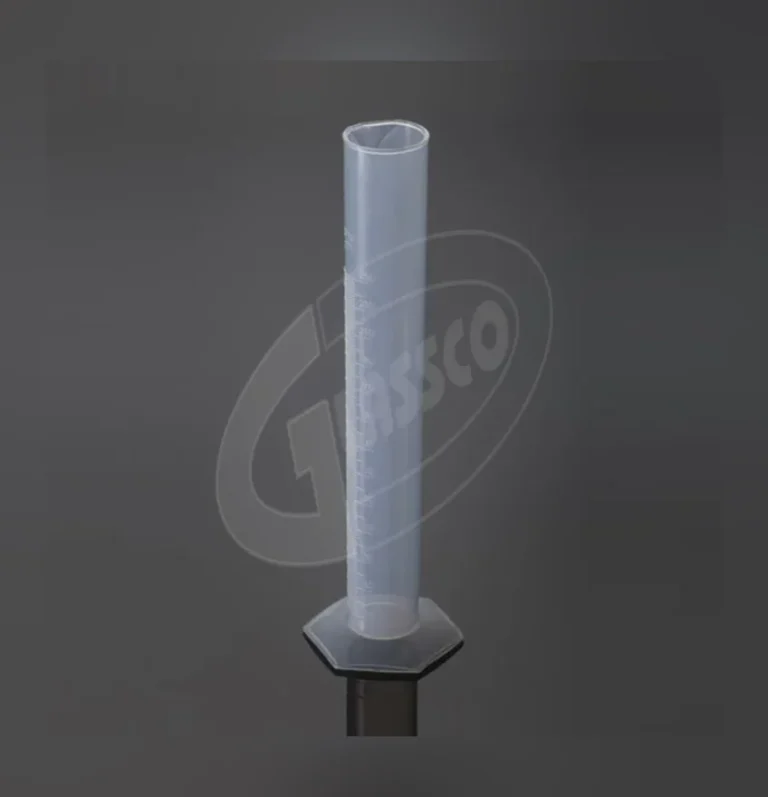
- Detachable PE base with protection collar — absorbs the impact that would otherwise chip a glass foot, and the collar protects the rim. The base can be replaced, and the whole cylinder is more forgiving of a teaching laboratory or a high-throughput bench.
Reading a cylinder without adding to the error
The class sets the manufacturing tolerance. Technique decides whether you also add a reading error on top of it.
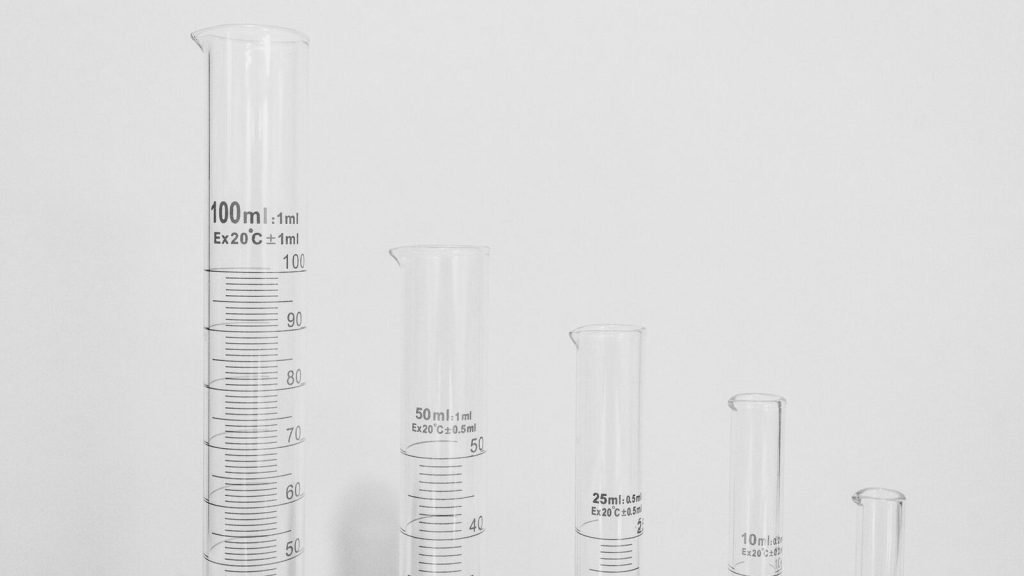
- Read at eye level. A cylinder viewed from above or below carries a parallax error that can exceed the whole Class A tolerance on a small cylinder.
- Read the bottom of the meniscus for transparent liquids, against a matt background.
- Stand it on a level bench, not in the hand. A cylinder held at a slight tilt reads high.
- Do not measure hot liquids. The calibration is at 20 °C, and both glass and liquid expand — the liquid far more.
- Do not use the top or bottom 10% of the scale if the result matters. Cylinders are least reliable at the extremes of the printed range.
Where a recorded number is needed and only a cylinder is available, the gravimetric method in ISO 4787 will tell you what the cylinder is actually delivering at the volume you use most.
A decision table for procurement
| Application | Instrument | Why |
|---|---|---|
| Analytical standard, calibration solution | Volumetric flask, Class A | A cylinder is 5 to 12× looser at the same volume |
| Volume recorded in a batch record or CoA | Cylinder, Class A with batch certificate | Traceability is the deliverable, not the tolerance |
| Reagent and buffer make-up to a written recipe | Cylinder, Class B | 1 to 2% is immaterial to the recipe |
| Rinse, transfer and waste volumes | Cylinder, Class B | The number is never used |
| Teaching laboratory | Cylinder, Class B, detachable PE base | Replaceable base survives handling |
| Volumes under 10 ml that matter | Pipette or small flask | A cylinder carries a full 1% at Class A below 50 ml |
Frequently asked questions
What is the difference between a Class A and Class B measuring cylinder?
Class B tolerance is exactly twice Class A at every capacity — ±1.00 ml against ±0.50 ml at 100 ml, ±0.50 ml against ±0.25 ml at 25 ml. Class A cylinders are also normally supplied with a batch certificate traceable to a national standard, which Class B cylinders are not.
Is a measuring cylinder accurate enough for preparing standards?
No. At 100 ml a Class A cylinder holds ±0.50 ml, five times the ±0.10 ml of a Class A volumetric flask, and a Class B flask is still more accurate than a Class A cylinder. Standards, calibration solutions and any volume that enters a calculation belong in a volumetric flask or a pipette.
Why does a small cylinder have a worse relative accuracy than a large one?
Because the tolerance does not shrink proportionally. Every cylinder from 5 ml to 50 ml carries a full 1.00% at Class A, while a 250 ml cylinder carries 0.40%. The graduation spacing on a narrow small-bore barrel cannot be printed and read finely enough to hold a tighter relative limit.
Does the batch certificate cover the individual cylinder I received?
It covers the production batch it came from, not that specific item. An individual certificate, which records the measured capacity of the one cylinder in your hand, is a separate and more expensive document. For most accredited laboratories a batch certificate plus in-house verification under ISO 4787 is the accepted position.
Can measuring cylinders be autoclaved?
The borosilicate 3.3 body can. A detachable PE base and any plastic collar should be removed first, and repeated thermal cycling will eventually move the effective position of the graduations on any glassware — which is why verification intervals exist. Check the class marking is still legible after each cycle; printing that has faded to illegibility ends the cylinder’s traceable life regardless of its physical condition.
Sources and further reading
- ISO 4788:2005 — Laboratory glassware: Graduated measuring cylinders
- ISO 384:2015 — Laboratory glass and plastics ware: Principles of design and construction of volumetric instruments
- ISO 4787:2021 — Laboratory glass and plastic ware: Volumetric instruments, methods for testing of capacity and for use
- ISO 3585:1998 — Borosilicate glass 3.3: Properties
- USP–NF General Chapter <31> — Volumetric Apparatus
Specification figures are taken from the GLASSCO measuring cylinder range stocked by PT Praglas Raya. Browse all measuring cylinders, read the accuracy class guide, or talk to our technical team about specifying for a particular method.