Short answer: borosilicate 3.3 expands about 3.3 × 10⁻⁶ K-1, roughly a third as much as soda-lime glass. That single property is why it survives a burner, an autoclave and a cold rinse, and why soda-lime does not.
Use borosilicate for anything heated, cooled quickly, held under vacuum, or used with strong chemicals. Soda-lime is adequate for unheated storage and display. Every glass item in the PT Praglas Raya range is borosilicate 3.3.
The grade is defined by ISO 3585, which fixes the properties a glass must have to be called borosilicate 3.3 — and the number in the name is the expansion coefficient. It is the rare case of a material grade that tells you the physics directly.
Where the difference comes from
Soda-lime glass — window glass, bottle glass, most kitchen glass — is silica with sodium and calcium oxides added to bring the melting point down. Those alkali ions make it cheap to form, and also make it move a lot with temperature and give up ions to water.
Borosilicate replaces much of that alkali with boron oxide. The resulting network is tighter and far less mobile, at the cost of a much higher working temperature during manufacture — which is most of why borosilicate glassware costs more.
| Property | Borosilicate 3.3 | Soda-lime |
|---|---|---|
| Linear expansion (20–300 °C) | 3.3 × 10⁻⁶ K-1 | ≈ 9 × 10⁻⁶ K-1 |
| Thermal shock resistance | ≈ 100 K | ≈ one third of that |
| Typical maximum working temperature | ≈ 500 °C, short term | Well below it |
| Hydrolytic resistance | Highest class | Two classes lower |
| Alkali resistance | Good, not immune | Poor |
| Typical use | Heated, cooled, evacuated, analytical | Ambient storage, display |
What thermal shock actually is
Glass breaks on temperature change because different parts of the wall change size at different times. The hot face wants to grow while the cold face holds it back, and the stress that builds between them exceeds what the glass can carry.
Two things reduce that stress: a smaller expansion coefficient, and a thinner wall. Borosilicate wins on the first. It is also why a thick beaker is more vulnerable to thermal shock than a thin one, which surprises people who assume heavier glass is tougher. Heavier glass is better against impact and worse against heat.
In practice this is the boundary that matters: a borosilicate flask taken from a hotplate to a cold bench survives; the same treatment cracks soda-lime.
What borosilicate does not survive
Borosilicate is chemically durable, not chemically immune. Three things attack it:
- Hydrofluoric acid dissolves it outright. Never store or handle HF in glass.
- Hot concentrated phosphoric acid attacks it steadily.
- Strong alkali — hydroxides above roughly pH 12, particularly hot — etches the surface. The damage is gradual and cumulative rather than dramatic, and it is the reason a Class A volumetric flask loses its calibration after years in a caustic dishwasher: the mark stays where it was printed, and the glass around it does not.
Etched glass also shows a matt, cloudy surface that never polishes out. That cloudiness is not dirt, and a flask that has it should leave analytical service.
Alkali damage never announces itself. Nothing breaks; the numbers just drift, and the glassware is usually the last thing anyone suspects.
PT Praglas Raya technical team
Autoclaving, and what it costs the glass
Borosilicate 3.3 autoclaves without difficulty at normal cycle temperatures. What matters is what surrounds the glass:
- Nothing sealed. A closed vessel in an autoclave is a pressure vessel. Loosen caps and remove ground stoppers.
- Remove plastic parts — detachable bases, protection collars, screw caps not rated for the cycle.
- Let it cool in the chamber. Pulling hot glass into room air is the thermal shock you spent the money to avoid.
- Watch the printing. Repeated cycles fade the enamel scale before they harm the glass. Once a graduation or a class marking is unreadable, the item has lost its traceability whatever its physical condition.
When glass is the wrong material entirely
Polypropylene and polyethylene beat borosilicate on impact resistance, weight and price, and are unaffected by hydrofluoric acid and strong alkali. They lose on clarity, on temperature, on dimensional stability and on the fact that many solvents swell or craze them.
The straightforward split:
- Glass — heated work, organic solvents, anything measured accurately, anything that must be seen clearly, anything stored long term.
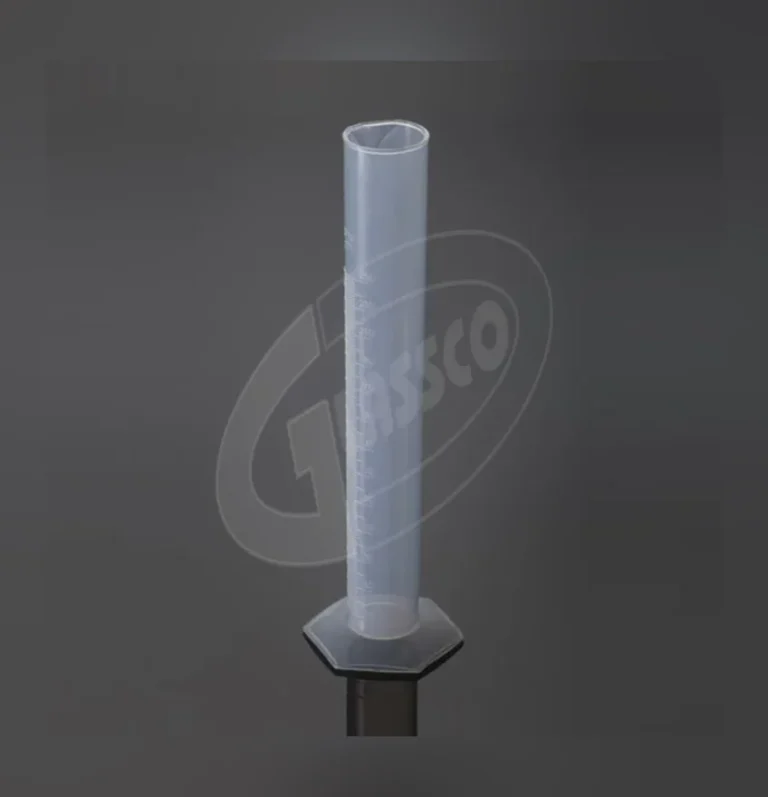
- Plastic — fieldwork, teaching, alkali and fluoride chemistry, rinse and waste handling, and anywhere a dropped vessel is likely. The reagent bottle guide works through the same choice for storage. The plastic measuring cylinder and the rest of the plasticware range exist for those cases.
Reading a piece of glassware
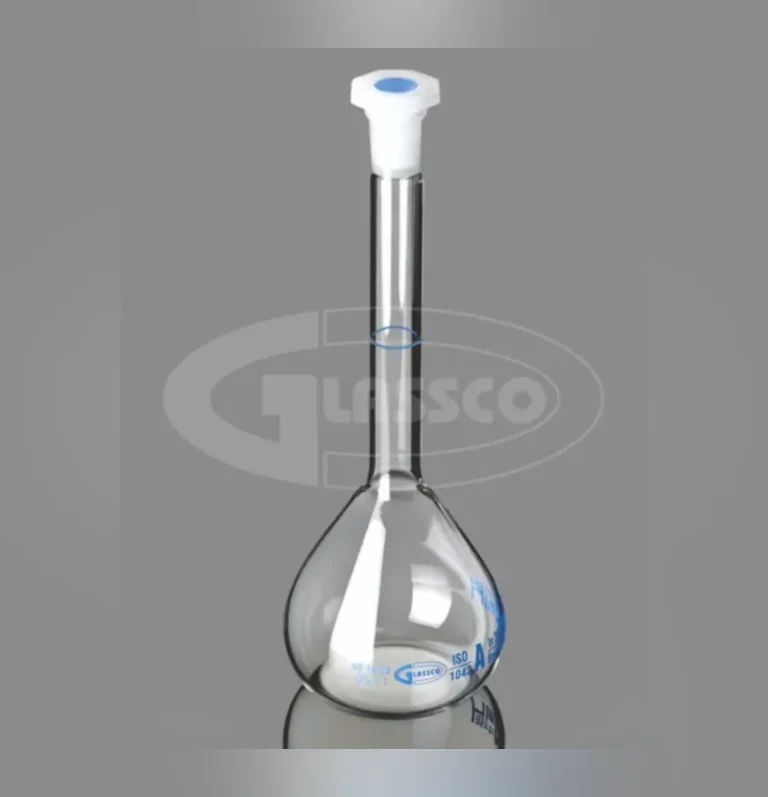
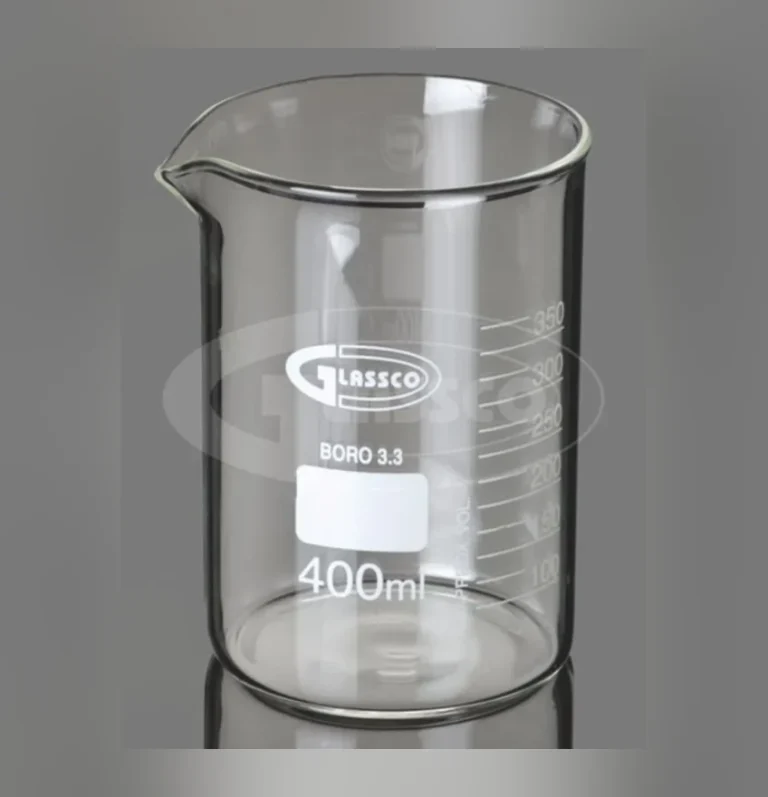
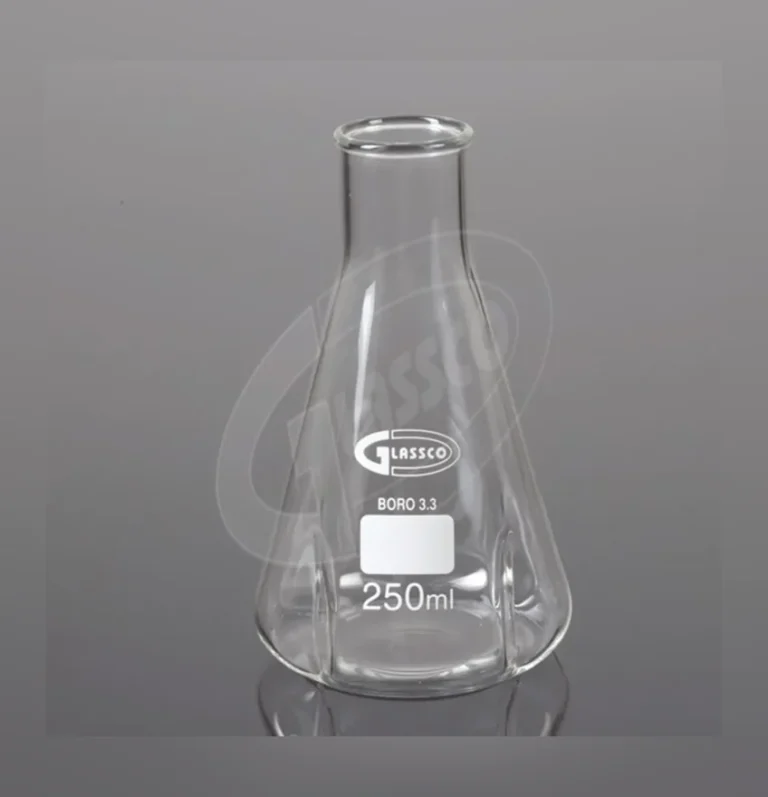
Well-marked laboratory glass tells you most of this itself. On the GLASSCO range you will find:
- Boro 3.3 — the glass grade, meaning the item meets ISO 3585.
- A class letter — A, AS or B, the volumetric tolerance, explained in the accuracy class guide.
- In or Ex — calibrated to contain, or to deliver.
- 20 °C — the reference temperature the calibration assumes.
- A joint marking such as 24/29 where a ground joint is present. See the guide to joint sizes.
Glass carrying none of these is not necessarily bad glass — but it is not laboratory glass, and nothing about its behaviour is guaranteed.
Frequently asked questions
What does Boro 3.3 mean on laboratory glassware?
It means the item is made from borosilicate glass with a linear thermal expansion coefficient of 3.3 × 10⁻⁶ K-1, the grade specified by ISO 3585. It is a statement about the glass, not about volumetric accuracy — that is the separate class marking.
Can I heat soda-lime glassware on a hotplate?
Not safely. Soda-lime expands about three times as much as borosilicate and tolerates roughly a third of the temperature change before it fractures. Anything that goes on a burner, a hotplate or into an autoclave should be borosilicate.
Is borosilicate glass resistant to all chemicals?
No. Hydrofluoric acid dissolves it, hot concentrated phosphoric acid attacks it, and strong hot alkali etches it progressively. For those three, use plastic.
Does thicker glass resist thermal shock better?
The opposite. A thicker wall holds a larger temperature difference between its faces, so the stress is higher. Heavy-wall glass is chosen for mechanical strength and vacuum work, not for thermal cycling.
How can I tell if glassware has been damaged by alkali?
Look for a matt, slightly cloudy surface that does not clean off, particularly inside the neck and around graduation marks. Damage of that kind is permanent, and any volumetric item showing it should be re-verified under ISO 4787 or withdrawn.
Sources and further reading
- ISO 3585:1998 — Borosilicate glass 3.3: Properties
- ISO 4803:2021 — Laboratory glassware: Borosilicate glass tubing
- ISO 384:2015 — Laboratory glass and plastics ware: Principles of design and construction of volumetric instruments
- ISO 4787:2021 — Laboratory glass and plastic ware: Volumetric instruments, methods for testing of capacity and for use
One piece of glassware sits outside this comparison: a desiccator is neutral glass rather than borosilicate, because it is never heated — see the desiccator guide.
Every glass item in the PT Praglas Raya catalogue is specified as Boro 3.3 on its product page. Browse laboratory glassware or the plasticware range, or talk to our technical team about a material choice for a particular chemistry.