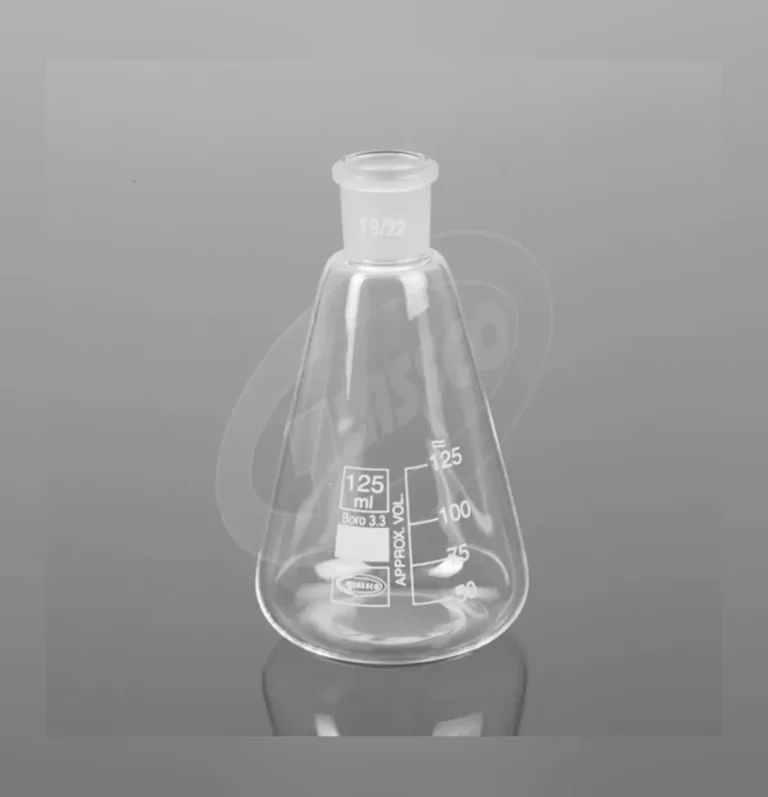
Short answer: a joint marked 14/23 is a ground conical joint whose wide end measures 14 mm across and whose ground surface is 23 mm long. Two joints fit each other only when both numbers match. A 14/23 stopper will not seal a 19/26 flask, and no amount of grease will change that.
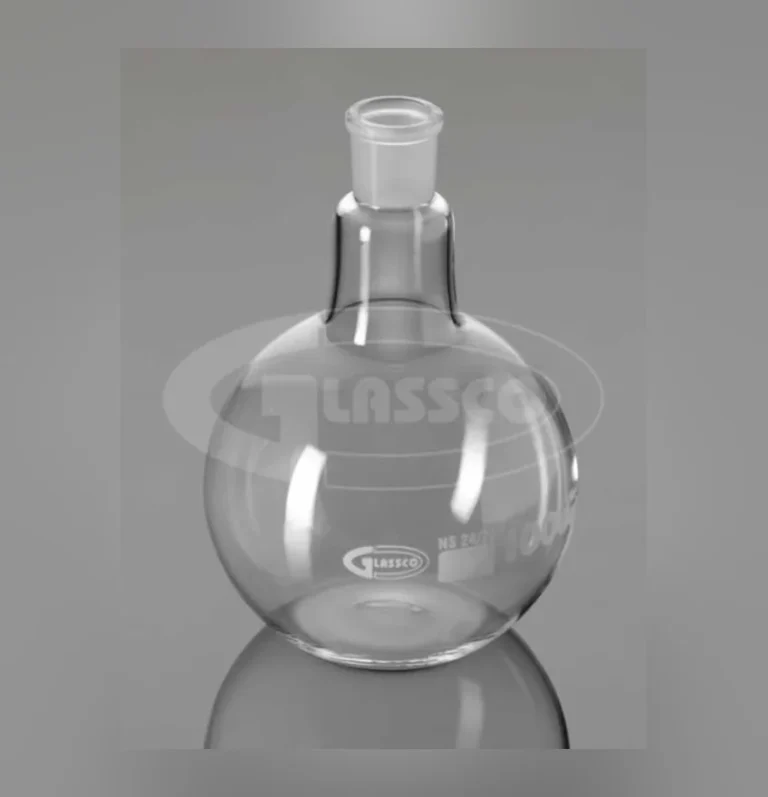
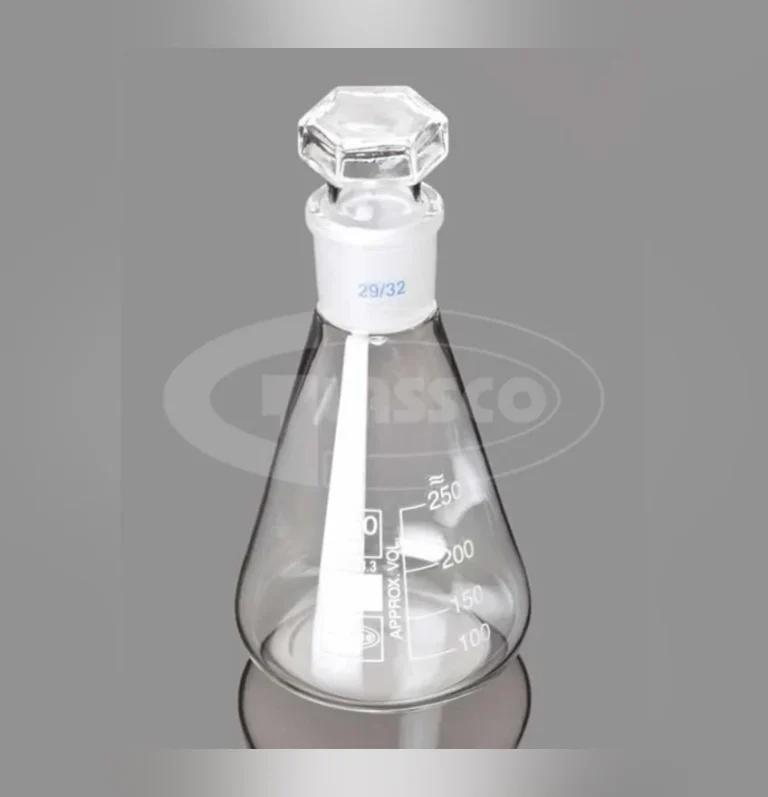
The same flask capacity is routinely supplied in several joint sizes. In this catalogue a 250 ml flat-bottom flask is stocked with five different joints — 14/23, 19/26, 24/29, 29/32 and 34/35. Ordering by capacity alone is not enough to get a flask that fits what is already on your bench.
Interchangeable conical ground joints are defined by ISO 383, which fixes the taper, the diameters, the ground length and the surface finish so that glassware from different makers assembles without leaking. The joint is the reason a laboratory can buy a flask from one supplier and a condenser from another and still build a working apparatus.
Reading the two numbers
Both figures are millimetres, and both matter.
- The first number is the diameter at the wide end of the cone — 14 mm on a 14/23, 29 mm on a 29/32. This is the number people quote, and the one that decides whether two pieces are even in the same family.
- The second number is the length of the ground surface. It sets how much sealing area the joint has, and therefore how well it holds vacuum and how firmly it grips.
Because the taper is fixed, the two numbers move together in a defined series. That is why you see 14/23 and 19/26 but never 14/26 — the combinations are set by the standard, not chosen by the manufacturer.
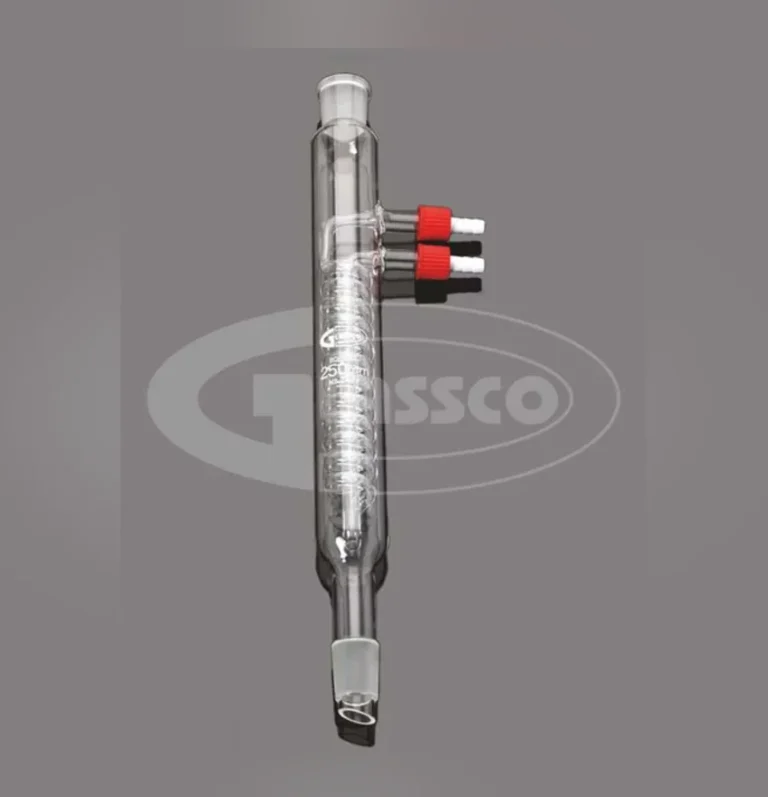
Every joint also has a sex. A socket is the female half, ground on the inside; a cone is the male half, ground on the outside. A flask normally presents a socket and a stopper or condenser presents a cone. Some items carry both: the Dimroth condenser in this catalogue has a socket at one end and a cone at the other, which is what lets it sit between a flask and a further piece of apparatus.
The joint sizes actually stocked
| Joint | Cone diameter | Typically found on |
|---|---|---|
| 10/19 | 10 mm | Volumetric flasks, 5 to 25 ml |
| 12/21 | 12 mm | Volumetric flasks, 50 and 100 ml |
| 14/23 | 14 mm | Volumetric flasks 50 to 250 ml; small reaction flasks; condensers |
| 19/26 | 19 mm | Volumetric flasks 500 ml; general reaction and boiling flasks |
| 24/29 | 24 mm | Volumetric flasks 1000 ml; the general-purpose size for mid-scale work |
| 29/32 | 29 mm | Volumetric flasks 2000 ml; the most widely stocked size in the range |
| 34/35 | 34 mm | Volumetric flasks 5000 ml; large boiling and conical flasks |
| 45/40 | 45 mm | 3000 and 5000 ml reaction and conical flasks only |
29/32 appears on more items than any other size in the catalogue, and 45/40 on the fewest — it exists only at 3000 and 5000 ml. If a laboratory is standardising on one joint for general work, 29/32 is the size with the widest choice of matching glass.
Why one capacity comes in several joints
A larger joint drains and vents faster, takes a wider stirrer or thermometer, and holds vacuum better. A smaller joint costs less, weighs less, uses less grease and puts less thermal mass at the neck. Manufacturers therefore offer the same vessel across a span of joints and leave the choice to the buyer.
| Capacity | Joint sizes available |
|---|---|
| 50 ml | 14/23, 19/26, 24/29, 29/32 |
| 100 ml | 14/23, 19/26, 24/29, 29/32 |
| 250 ml | 14/23, 19/26, 24/29, 29/32, 34/35 |
| 500 ml | 19/26, 24/29, 29/32, 34/35 |
| 1000 ml | 19/26, 24/29, 29/32, 34/35 |
| 2000 ml | 24/29, 29/32, 34/35 |
| 3000 ml | 29/32, 34/35, 45/40 |
| 5000 ml | 29/32, 34/35, 45/40 |
The practical rule: decide the joint size first, at the level of the whole laboratory, then buy capacities within it. A bench standardised on 24/29 can assemble any flask with any condenser it owns. A bench that bought each flask on price ends up with a drawer of glass that does not connect.
The most common return request we handle is not a broken flask. It is a flask that arrived in the right volume and the wrong joint.
PT Praglas Raya technical team
The volumetric flask exception
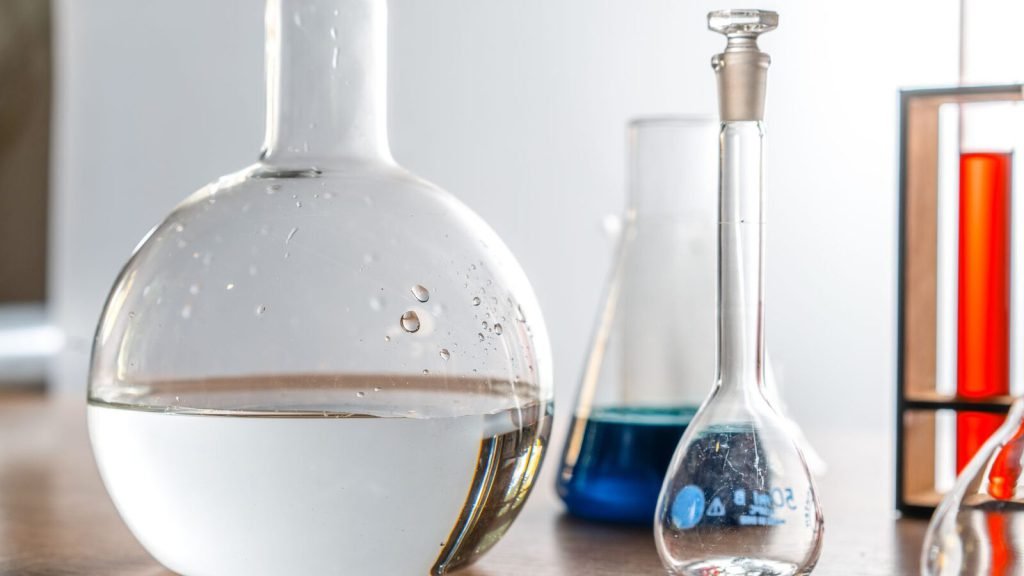
On a one-mark volumetric flask the joint size is not a free choice — it tracks capacity, because the neck bore is part of what makes the flask accurate. In the GLASSCO range it runs 10/19 up to 25 ml, then 12/21 or 14/23 at 50 and 100 ml, 14/23 to 250 ml, 19/26 at 500 ml, 24/29 at 1000 ml, 29/32 at 2000 ml and 34/35 at 5000 ml.
Note the split at 50 and 100 ml: both capacities are stocked with two joints. Order a replacement stopper against the wrong one and it will not seal, even though the flask volume is correct.
Grease, seizing and how joints are lost
A ground joint is two matched abrasive surfaces held together by contact. Three things destroy them:
- Alkali. Sodium and potassium hydroxide attack the ground surface and weld the two halves together. A joint that has held hydroxide overnight often cannot be separated without breaking it.
- Heat with the joint closed. Warming a sealed assembly raises internal pressure and drives the cone into the socket; cooling then locks it.
- Grit. Any solid caught between the surfaces scores them, and a scored joint leaks for the rest of its life.
Grease seals and protects, but it is also a contamination path — it dissolves in many organic solvents and will find its way into the sample. Where the chemistry allows it, a PTFE sleeve is the better answer: it seals, it never seizes, and it contributes nothing to the analysis.
Separate joints after every use, clean them promptly, and store cones and sockets loosely together rather than assembled. The same rules apply to the ground flange of a desiccator, which fails in exactly the same ways.
Frequently asked questions
What do the numbers on a ground glass joint mean?
The first is the diameter in millimetres at the wide end of the cone, the second is the length of the ground surface in millimetres. A 24/29 joint is 24 mm across and ground over 29 mm. Both numbers must match for two pieces to fit.
Can I use an adapter between two different joint sizes?
Yes — reduction and expansion adapters exist for exactly this, and they are the correct fix for a one-off mismatch. They are not a good basis for a whole laboratory: every adapter adds two more sealing surfaces, more dead volume and another thing to seize.
Why does my new flask not fit my old stopper?
Almost always because the capacity matched and the joint did not. In this range both 50 ml and 100 ml volumetric flasks are stocked in two different joint sizes, so a correct-volume replacement can still arrive with the wrong neck. Check the joint marking on the glass before ordering.
Should I grease ground glass joints?
For vacuum work and for anything held at temperature, yes — or use a PTFE sleeve. For routine aqueous work at atmospheric pressure a clean dry joint is usually enough, and avoids the contamination that grease brings. Never grease a joint that will contact a sample destined for trace organic analysis.
Which joint size should a laboratory standardise on?
For general synthetic and distillation work, 24/29 or 29/32 — the two sizes with the widest choice of matching glass in this catalogue. Smaller sizes suit micro-scale work, and 45/40 is only needed on 3000 ml and larger vessels.
Sources and further reading
- ISO 383:1976 — Laboratory glassware: Interchangeable conical ground joints
- ISO 4797:2015 — Laboratory glassware: Boiling flasks with conical ground joints
- ISO 1042:1998 — Laboratory glassware: One-mark volumetric flasks
- ISO 3585:1998 — Borosilicate glass 3.3: Properties
Joint sizes quoted are taken from the GLASSCO specification tables on the product pages of this site. Browse laboratory flasks and laboratory glassware, read the guide to borosilicate glass, or talk to our technical team with the joint size you already run.